
Possible Love: A Cross-Class Friendship Implodes in Lee Chang-dong's masterpiece
By Liam Lacey
Rating: A+
“I feel like I’m in a novel I haven’t read,” says Mi-ok, surveying the lavish summer mansion of a wealthy new acquaintance. It’s a phrase that could describe South Korean director Lee Chang-dong’s multi-layered, witty and grandly moving, seventh feature, Possible Love.
Following festival screenings at Venice, Toronto and New York, Possible Love arrives in theatres as one of the year’s most critically acclaimed films. Though audiences have shown they will sit through three-hour movies that have the hype of Christopher Nolan’s The Odyssey or Nathan Fielder’s You Can See Anything, a Korean language social drama from an art house director is obviously at some disadvantage.
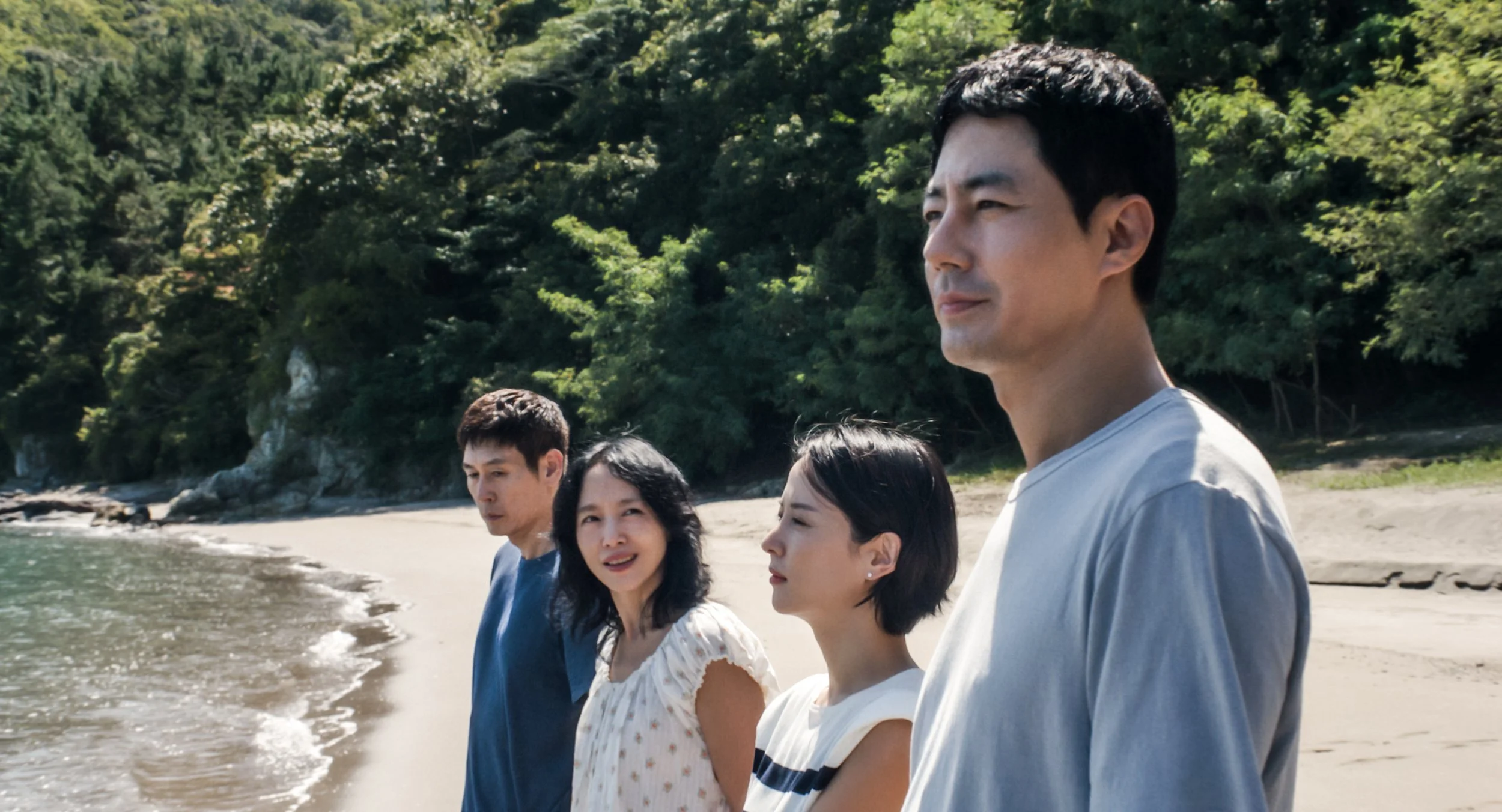
Two couples separated by social class try to bond in Lee Chang-dong’s Possible Love.
Fortunately, following its theatrical run which begins this week, Possible Love will be available to stream on Netflix on Nov. 6.
Lee, now 72, started as a novelist (he was also, briefly, Korea’s Minister of Culture) whose directing career did not begin until he was past 40. He makes films that feel like great literature. This is not meant in the Masterpiece Theatre sense of carefully plotted narratives with engraved chapter headings and voice-over reminiscences, but in revealing the rich, contradictory inner experience of his characters, the quality Henry James called “felt life.”
Lee is not prolific: His last film, eight years ago, was Burning, a psychological thriller that ended up on many critics’ top 20 lists. Burning came eight years after his previous film, Poetry, a melodrama about a woman in the early stages of Alzheimer’s who discovers the power of poetry, and which won best screenplay at the Cannes film festival. Though Lee’s output is small, he is a central figure in the New Korean Cinema (Bong Joon-Ho, Chan-Wook Park, Hong Sang-Soo) which emerged after the military dictatorship, exploring issues of social status and the kind of seismic economic shifts that are felt around the globe.
In Possible Love, Lee turns his gaze on two couples from different economic levels. Jeon Do-yeon (the Cannes best-actress star of Lee’s Secret Sunshine), plays the working-class Mi-ok, a housewife in the employ of a paper-making factory, while struggling to care for her withdrawn 10-year-old son, Cheol (Jung Seol).
Cheol is a furtive observer of the tensions between Mi-ok and her husband Ho-seok (Sul Kyung-gu), Ho-seok routinely drinks himself into a stupor to dull his rage following his loss of his factory job. The factory downsizing has led to a rash of suicides in the area.
During a reception at a community centre following the funeral for one of the laid-off co-workers, Mi-ok chances to meets another couple, Ye-ji (Cho Yeo-jeong, of Parasite) and her rich husband, Sang-woo (Zo In-sung). Ye-ji is a middle-class woman who met her wealthy husband when they were both students in the United States. She says she wants to make a documentary about the decline of labour, inspired by a visit to Qatar. (Her husband could easily finance her hobby, but she’s tapped into government funding to make it more authentic.). She wants Mi-ok and her husband to be her subjects.
The sociable Mi-ok agrees, but Ho Seok declines. The initial encounters play out as satire: When Ye-ji goes to shoot at the factory where Mi-ok works, the novice filmmaker finds the material too repetitious, and so she tries to inject some drama into the film by urging the handful of workers to unionize.

Mi-ok, anxious to help, suggests Yi-ji might find it easier to relate to the workers if she didn’t wear her designer clothes behind the camera. When she admires her purse, Ye-Ji purports to be unaware of its value, so Mi-ok furtively photographs the purse with her phone camera to check the price online.
She’s also fascinated with her new friend’s husband, the handsome Sang-woo, who reminds her of Apple co-founder Steve Jobs, (which is only true inasmuch as he’s confident and rich.) Sang-woo, who has a rich man’s sense of noblesse oblige,, takes everyone out to an expensive dinner; the women get drunk and bond as almost equal, which means they giggle and call each other “bitch.” .
Possible Love carries the dedication to Krzysztof Kieślowski’s Decalogue 1989 television series and is part of an internationally planned 10-film series honoring the Polish filmmaker’s masterpiece, based on the Ten Commandments. Lee’s film is inspired by the Tenth Commandment, the proscription against envy: “Thou Shalt Not Covet.” For Mi-ok, the association with her wealthy friend exposes the limits of her old aspirations, of the cottage she and her husband bought, with its small patio and the unused outdoor table where Ho-seok imagined he would spend evenings drinking with his factory friends, a constant reminder of small dreams unfulfilled.
Possible Love reaches its climax when Sang-woo and Ye-ji decide to invite the couple to family’s coastal mansion, a place with a vast library, forest lanes, a beach front and a resident man servant, Min-sik who was Sang-woo’s childhood playmate. In an exchange that gives the movie its title, Sang-woo suggests that his wife is “method acting” her expressions of empathy with the blue-collar couple. She retorts that it’s a “possible love.” We can also see her agenda is to get the money-shot interview for the documentary, an interview with the emotionally troubled Ho-seok.
Add to the complications Mi-ok’s increasingly overt attraction to her handsome host, and her husband’s seething rage and copious booze in the uncomfortable surroundings, make this a house party to remember. Also included is the boy, Cheol, hiding around corners and staging his own subtly funny intervention.
One reason for Possible Love’s extended running time is that it also uses flashbacks to tells us of Mi-ok and Ho-seok’s backstory, how this somewhat mismatched couple first met as teen-agers, how he refused her accept her rejection, and the bond that holds them together through difficult times, including the factory strike, that turns into television footage of the violent government crackdown that left him physically and psychologically broken.
There’s a lot of pain in Lee’s film, especially in Sul’s portrayal of Ho-seok, a man without the tools to express his helpless anger and shame. But there’s humour and joy as well in Jeon Do-yeon’s performance, which conveys both innocence and a warm intelligence that illuminates this exceptional film.
Possible Love. Written and directed by Lee Chang-dong. Starring: Jeon Do-yeon, Sul Kyung-gu, Zo In-sung, Cho Yeo-jeong. Possible Love screens in Vancouver (VIFF Centre, Oct. 23-29), Toronto (TIFF Bell Lightbox, Oct. 23-29), Ottawa (the Mayfair Theatre, Oct. 23, 26, 27 and 29) and Montreal (Cinéma Moderne, Oct. 23, 27,29 and Nov. 1).