
Original-Cin Q&A: Being Heumann’s Director and Star on Giving Disability Visibility
By Bonnie Laufer
In 1977, a group of disabled activists took over a federal building in San Francisco for 25 days during an historic protest known as the Section 504 sit-in that fundamentally reshaped civil rights in America.
At the centre of that movement was Judy Heumann, whose fierce advocacy paved the way for generations to come. Now, her life and legacy are spotlighted in the new drama Being Heumann, directed by Oscar winner Siân Heder (CODA).
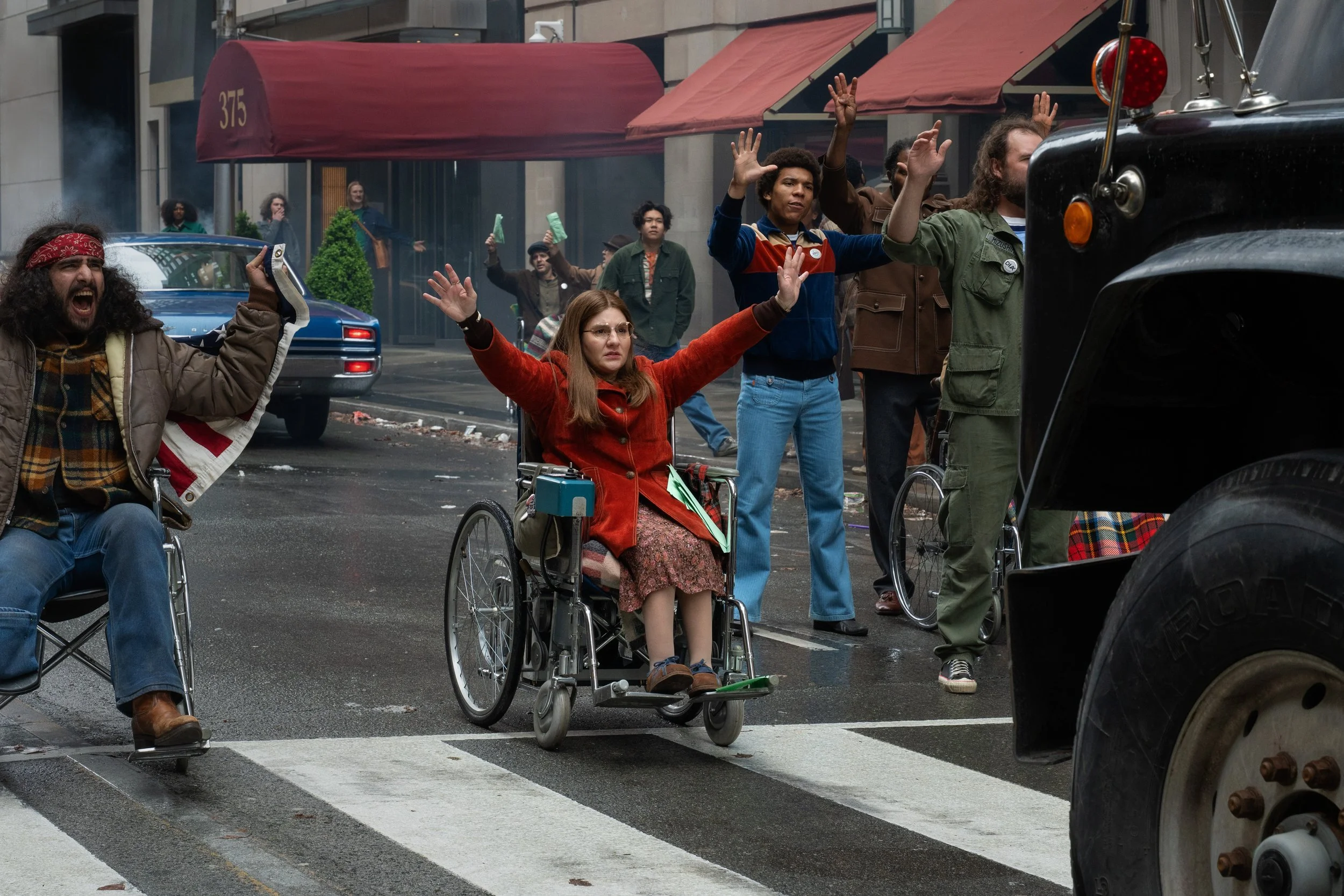
Joining Heder to bring this vital history to life is BAFTA-nominated actress Ruth Madeley, who delivers a powerhouse performance as Judy. Original-Cin spoke with Heder and Madeley to discuss honouring Judy’s legacy and Heder’s devotion to telling stories that feature disabled actors.
Being Heumann, which debuted last fall at Toronto International Film Festival, premieres globally November 13 on Apple TV.
ORIGINAL-CIN: Not only did you shoot Being Heumann in Toronto, it was chosen as the opening night gala at this year’s TIFF.
SIÂN HEDER: It was awesome and such an honour. I had never been to TIFF, which I cannot believe. It was an extraordinary night. Toronto is a city made up of film lovers, true film lovers, and the feeling at our premiere was magical.
RUTH MADELEY: It was the best homecoming.
O-C: Ruth, playing Judy Heumann could not have been easy. She had such a strong public persona advocating for disability rights. How difficult was it for you to embody her personally, or for you to know who she was personally?
RM: I started at a very particular place on the first day of shooting and I ended somewhere very different on the last day. I read everything I could get my hands on about Judy and watched countless videos. The other day my husband was watching an old interview with her, and he literally said he thought she was there when I came into the room. I consumed so much and I found that in a weird way that started to be a hindrance. I quickly realized that I didn't want to do an imitation of her. I wanted to really find the truth and the feeling of what she was going through. One of my favourite parts of working on the film was collaborating with Siân. I loved finding the smallest things on the page that seemed insignificant but were so important.

O-C: She was complex, such a driven and determined person.
RM: Such an inspiration but we focused on the period when she wasn't an icon. She was controversial, some people perhaps didn't know or see her own uncertainty. There’s a point in the film where she is questioning what she is doing and she says, ‘What if we fail?’ It made me look from where she started. I was like, ‘She's Judy Heumann. Surely, she could never have thought that she would fail.’ But that just made this story even more powerful. She was not perfect and pissed a lot of people off, but she never backed down.
O-C: Siân, you and Judy shared a close, two-year working collaboration before she died in 2023. She gave you her blessing to turn her memoir into a film. You have been a huge champion of the disabled, casting disabled actors in film. So, what have you learned about yourself? How did you change?
SH: A lot. Ruth has been talking about Judy learning as a leader. I learned about leadership working on this film. I think I underestimated the task in front of me. If I'm being honest, I knew it was going to be hard. Casting actors with many different disabilities was a challenge, but I didn’t think about logistics. I kept asking for more to be in key crowd scenes and I kept saying, ‘We'll figure it out,’ and then added more. ‘Give me 60 other disabled extras. It'll be fine. We'll work it out.’
O-C: Even as we see in the film, there’s a lot to consider and precautions that need to be arranged.
SH: Exactly. For example, when I was in front of a crowd, and we were having to take care of people's bodies in real time, you're still under the pressure of making a movie and you've got to keep going. You've got limited days, and you're in a location, and you can't go back there. But somebody's having a medical crisis, and they can't be in the scene. I think for me, I feel like I went through Judy's journey when she and the protestors were in the building in real life and would not leave. That’s what it felt like making the movie. I had to dig deep to figure out how to keep going, keep everybody safe and believe in the bigger mission, even though the day-to-day was so hard.