
Lord of the Rings: The Rings of Power, Season 3 - Still Tolkien-Faithful Millennia Later
By John Kirk
Rating: A
It’s a monumental task to adapt the works of the greatest fantasy writer of all time to either large or small screen. It takes vision, patience, imagination and an exasperating amount of attention to detail.
But those are also required of the audience who loves those works as well. And if they love the works, they will love the work that went into the adaptation.
You can argue that forebearance plays a role in this endeavour as does creative license, but the long and short of it lies in patience. Prime Video’s The Lord of the Rings: The Rings of Power (Season Three) drops this week and it’s probably the most intricate adaptation of a work I’ve ever seen.
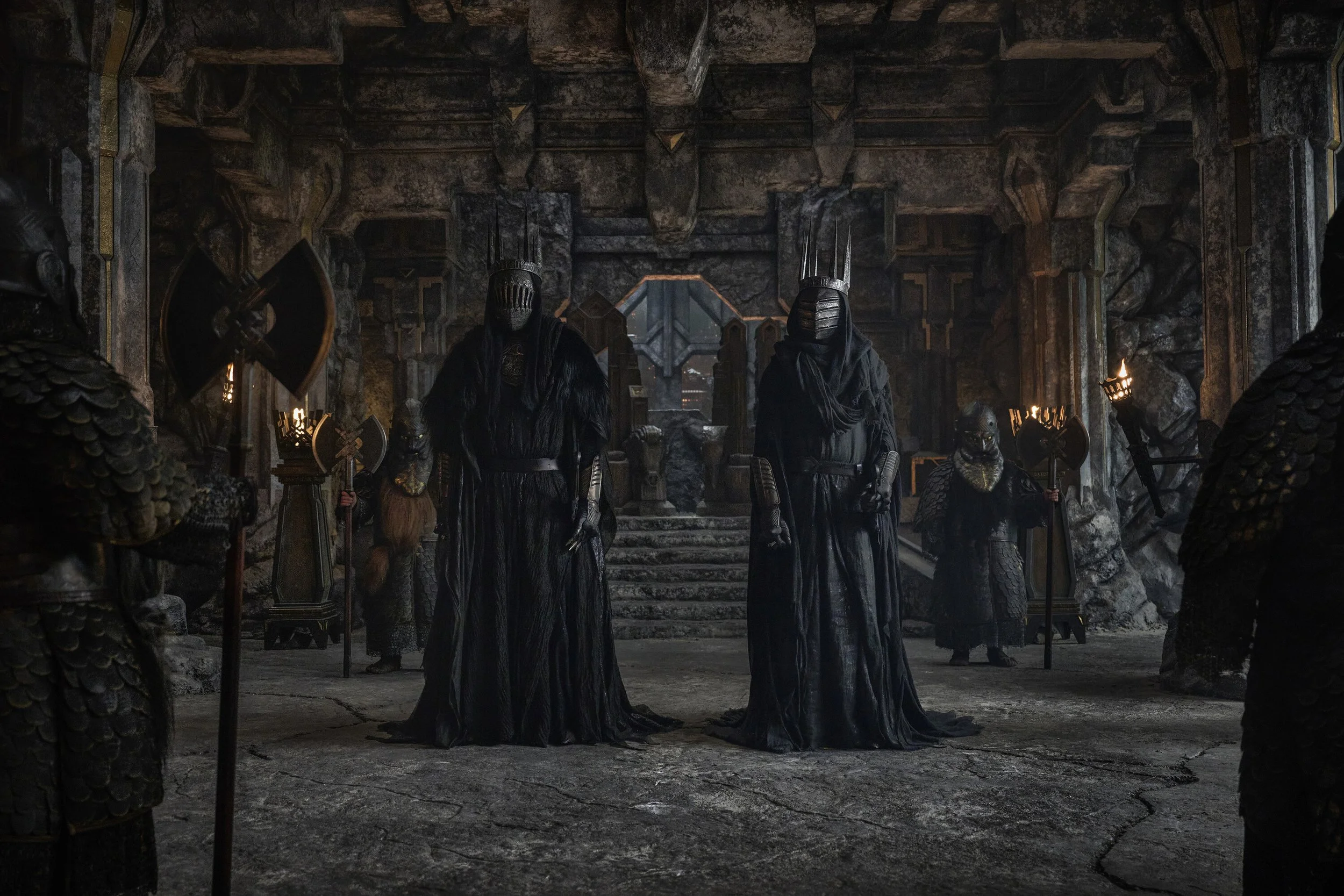
Two Nazgnagol, human lords enticed by Sauron and the Ring into becoming thralls.
For one thing, the absolute scope and epic time frame of this history is monumental. Even though the rights to The Silmarillion were not secured for this adaptation (that’s a lengthy explanation, but essentially those film rights were kept by the Tolkien Estate), the extrapolative work done by the showrunners, using existing film rights (The Hobbit, The Lord of the Rings AND its appendices) is a stupendous undertaking.
If you’ve ever read the appendices to the Trilogy, they’re very much like stories unto themselves, but they read like an academic summary of historical events, like a textbook. While people, places and times are mentioned, allowing for the essentials in a story, they lack prose features like dialogue and exposition - art, forcing those writers to supply that creative dimension to the adaptation.
And that’s a pretty tall order.
We’re dealing with a time frame that spans millennia and beings who are effectively immortal. The confines of our own mortal existence is enough to hamper our understanding of those concepts. When you see Lady Galadriel (Morfydd Clark) transition from a little girl, to a warrior, to a regal high lady, all within twelve episodes, it’s sometimes difficult to remember that these changes happened over thousands of years. That is the limitation of the of the medium in which this story has been adapted.
Also, it’s important to remember that what we are watching is not an actual story like the Trilogy. The key to that successful adaptation was that material could be removed and the story would still transpire. We don’t see Tom Bombadil in the Peter Jackson films nor do we see the scouring of the Shire. In The Rings of Power, writers are extrapolating events described on a timeline in the appendices of the Trilogy.
Still, from what I can see (and what I know about Tolkien’s works, and trust me – that’s a lot), the events and the historical persons of those appendices are fully detailed and brought to life in this series. Yes, they are interpreted because there are no stories, only descriptions to work from.
Then we need to look at the work itself. In our interviews with showrunner J.D. Payne and some of the cast, Payne told us that the storytelling was constrained by the limits of the medium. But it is the touchstones of the original work that they tried to portray. Seeing those characters and ideas come to life is what connects the fans of this franchise to the enjoyment of the show. In my humble opinion, it’s a remarkable testament to the fundamental nature of Tolkien’s work.
Which is what we have to remember this is. Every mythology has an origin story. This is Tolkien’s, but because it is literally an entire world with a complete cosmological perspective to its creation, the scope of its beginnings is on a biblical level. It includes the origins of gods, entire races, the formation of geological features like Mount Doom – this is fictional creation at its most extravagant level.
It is easier to conceptualize the Trilogy and The Hobbit because they were straightforward stories. The Rings of Power isn’t a typical adventure. It is a narrative explanation of how The Hobbit and the Trilogy came to be.
Where the show does draw audience criticism is those moments when it sometimes ham-fistedly presents those touchstones in those works. For instance, Nori Brandyfoot (Markella Kavenagh) is a Harfoot, a sort of primeval version of a Hobbit. It is her character who makes friends with Daniel Weyman’s Gandalf, in a blatant emulation of the friendship between Gandalf and Frodo in the Trilogy.
This isn’t a fault of the story, but it could be seen as a fault of a choice in storytelling with how blatant parallel stands out. Still, there is no definitive information on how Gandalf arrived in Middle-Earth. He is a celestial spirit and an Istari, how he arrived is open to creative license. This is the purview of the writers. These are missing gaps in the history, apparent only to those who know Tolkien’s lore well.
Fantasy is an exhausting venue in which to craft a story. Magic is a difficult subject to conceptualize because there are no limits to it. And Tolkien’s work is the purest example of fantasy, which is why its fans love it so much.
Season Three of The Rings of Power promises to be worthy of that love because of the work that went it, and the relative faithfulness of its approach.
Lord of the Rings: The Rings of Power, Season 3. Showrunners: J.D. Payne & Patrick McKay. Cast: Morfydd Clark, Charlie Vickers, Robert Aramayo, Ismael Cruz Córdova, Daniel Weyman, Owain Arthur, Sophia Nomvete, Cynthia Addai-Robinson, Lloyd Owen, Benjamin Walker, Charles Edwards, Ciarán Hinds, Rory Kinnear, Markella Kavenagh, Megan Richards, Jamie Campbell -Bower, Eddie Marsan, Andrew Richardson, Zubin Varla, Adam Young
Lord of the Rings: The Rings of Power streams on Prime Video November 11.