
Blade Runner: 2099 - Series Sees Replicants Run the Show, While Yeoh Owns the Screen
By John Kirk
Rating: A-
The original Blade Runner was a cinematic slow burn that, while it flopped at the box office, was eventually recognized for its intricate storytelling wrapped in a cloak of noir, and it influenced a generation of cyberpunk sci-fi writers.
Blade Runner: 2099, which burns over eight episodes, keeps that intricacy and gives fans exactly what its replicant characters want: more life.
The series manages to capture the measured suspense of the original film. But it reaches beyond the nostalgic and unveils an evolutionary narrative worthy of its predecessor.
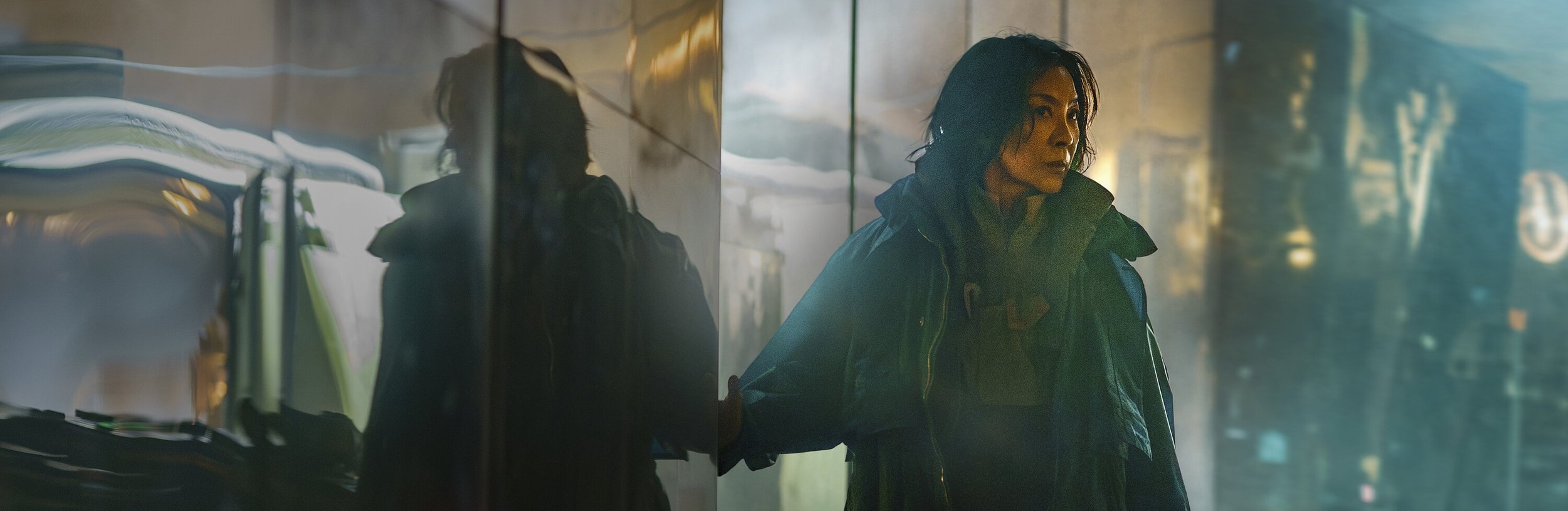
Michelle Yeoh is a replicant with time running out in Blade Runner 2099.
In 2099, the replicants are the dominant class in Los Angeles. They are the government and, taking the name of the Blade Runners that once hunted them, they are now also the police. Humans are reduced to menial jobs, and replicants are now free to explore their genetically-engineered human-like consciousness.
Cora (Hunter Schafer) is a human and her crippled brother’s caregiver. In order to get them out of the city and to a place of better medical care, she has to recover a priceless object hidden in the heart of the Los Angeles Police Department’s property division. To do so, she must impersonate a replicant Blade Runner.
With this object, she can manage to get to Mexico City, get better health care for her brother and a better life away from the replicant-run Los Angeles, which was taken in the civil war between humanity and its creations.
It has importance as well for a replicant Blade Runner named Olwen (Michelle Yeoh), as it was an object her missing friend, Marek (Johnny Harris) was also mysteriously interested in. Olwen, nearing the end of her life span, must partner up with the imposter Cora.
What makes this series stand out is the openness of the mystery. In the previous two films, the depth of this world and its impact upon the characters in Ridley Scott’s vision, obfuscated viewers’ interpretation of the plot, lost in the trappings of the unique futuristic setting (Who is a human? Who is a replicant? Are you sure?).
This made the film a work of art, minus the fast-paced storylines of conventional science fiction films. It brooded, obscuring motivations and plot. The audience was entranced by the overwhelming dystopian nature of the story. This series adheres to the setting but focuses more on the story.

One aspect of that accountability, given that the replicants are the ruling class in Los Angeles, is the terrifying reality of Cora’s predicament in impersonating one.
The frailty of humans compared to their genetically-engineered offspring factors into the story. While Cora and Olwen race to find the missing secret, the audience is painfully aware of how inferior Cora is in trying to keep up with Olwen. To see Michelle Yeoh pick people up with one hand and toss them around like rag dolls reminds us of her talent and versatility.
How does one act inhuman? The nature of replicants is that while they may look like fully grown adults, they lack human emotional range. They may appear 30 or 40 years old and have superior physical or intellectual abilities, but they have the awkward emotional responses of children. Seeing the series develop over eight episodes allows the audience and fans of the series to see more of the replicants as people.
There’s also an expansion of the world Ridley Scott created. Showrunner Silka Luisa expands this world beyond L.A. With 50 on-screen years having passed since the last film (Blade Runner 2049), we learn more about off-world colonies, cities and territories elsewhere in dystopian North America.
It also revisits the Replicants’ one existential weakness: their limited life spans. The theme of wanting more life, to share the unique experiences that only they can encounter, is a reverberant echo back to Rutger Hauer’s monologue in the first film. They have seen things we can’t imagine. Such moments in every episode of this series remind us of that haunting message.
Over eight episodes, the slow, smoky burn with ‘80s synthesizer soundtrack vibes continue as we revisit this world from a more evolutionary perspective. We see the series unfold into a poignant and deserving legacy to the original masterpiece.
Blade Runner: 2099. Producers: Ridley Scott, Silka Luisa. Director: Jonathan Von Tulleken. Cast: Michelle Yeoh, Hunter Schafer, Dimitri Abold, Tom Burke, Lewis Gribben, Johnny Harris, Matthew Needham.
All eight episodes of Blade Runner 2099 stream on Prime Video starting November 25.