
Wild Horse Nine: McDonagh’s Latest a Portrait of Male Friendship, Dark and Funny
By Chris Knight
Rating: A
If The Odd Couple hadn’t been made as a play, a hit movie, and then a television series right around the time Martin McDonagh was born, you can be pretty certain the Irish playwright would have made something like it — only darker — in his own lifetime.
Through his turn-of-the-century plays and his more recent work as a screenwriter-director, McDonagh often focuses on dark, violence-tinged male friendships. The quintessential examples are 2008’s In Bruges, starring Colin Farrell and Brendan Gleeson as a pair of hitmen, and 2022’s The Banshees of Inisherin, featuring the same duo as lifelong friends going through a falling-out.
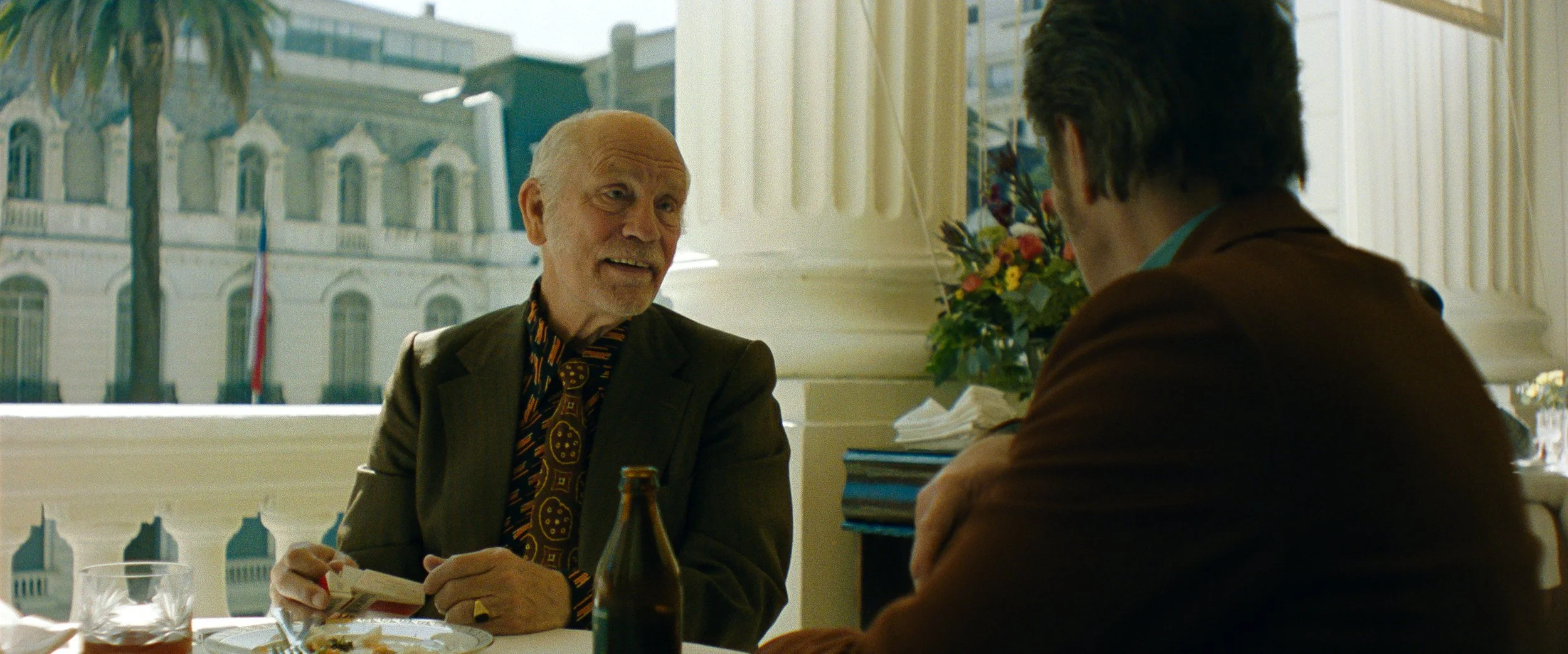
Wild Horse Nine give the concept an American twist, with Sam Rockwell as Lee Chesterfield and John Malkovich as Chris Carlisle, two CIA operatives working in 1973 Santiago shortly before the military coup that ousted Chile’s Marxist leader.
They are deeply involved in that plot, and in several others of the era: In the opening scene, Malkovich mentions that he was in Dallas in November of ’63 and gleefully mouths the word “success.” McDonagh sugarcoats his film with a tasty dollop of paranoia and conspiracy; references to the Zapruder film and a missing rifle feature prominently.
The men are on their way to Easter Island to see “the big heads,” and woe betide anyone who mentions they’re actually called moai and that the island’s Indigenous name is Rapa Nui.

Back in Santiago, their boss (Steve Buscemi, playing a boffin of bureaucratic bluster) makes angry calls demanding that Lee keep closer tabs on Chris, who has a habit of discussing the more classified details of their work with anyone who’s attractive, and who is also working on a memoir. One senses that, one way or another, this might be his last assignment.
It’s a pleasure to hear McDonagh’s words tumble out of these men’s mouths. They have a tendency to interject a “huh?” or “what?” as if they didn’t quite hear, or comprehend, or even believe the other’s previous line. Repetition, particularly in Malkovich’s mellifluous tones, makes it funnier. There’s a great bit that is kicked off by Chris’s boast that “I’ve killed people in countries you can’t even spell.”
The script also enjoys sprinkling in subtle hints and mentions, seeds that only sprout much later in the film, when a turn of phrase turns out be more than just a metaphor, or a character trait observed by one man suddenly manifests in another. I don’t want to spoil any specific examples, but you’ll know them when they arrive.
Wild Horse Nine includes a few wonderful needle drops, with snatches of Joni Mitchell, Hank Williams, Diana Ross and even Tom Waits on the soundtrack. And as befits the title, the wild horses of Easter Island provide an even more meaningful backdrop than the “big heads.”
But it all hinges on the friendship between the two main characters, who bicker and argue and swear and threaten and also clearly love one another. There are several moments of tenderness, and one that even moved me to tears, but a great example from mid-movie was when Malkovich’s character complains to Rockwell over a meal that he doesn’t know whether he can trust him or not.
Rockwell gives him a long look, closes his eyes, shakes his head and says: “You can. You’ve just forgotten that you can.” Malkovich responds: “That’s easy for you to say.” Rockwell looks across the table and says quietly: “It isn’t, really.”
Wild Horse Nine. Directed by Martin McDonagh. Starring John Malkovich, Sam Rockwell, and Steve Buscemi. In theatres November 6.