
Original-Cin Q&A: Dracula's Christoph Waltz Dislikes Stoker's Novel, But Loves Besson's Vision
Two-time Oscar winner Christoph Waltz steps into the shadowy world of Dracula as The Priest, bringing his signature intelligence and unpredictability to the iconic tale.
The film, written and directed by Luc Besson brings us a romantic reimagining of the classic vampire story, focusing on a 15th-century prince (Caleb Landry Jones) who renounces God after his wife’s death.
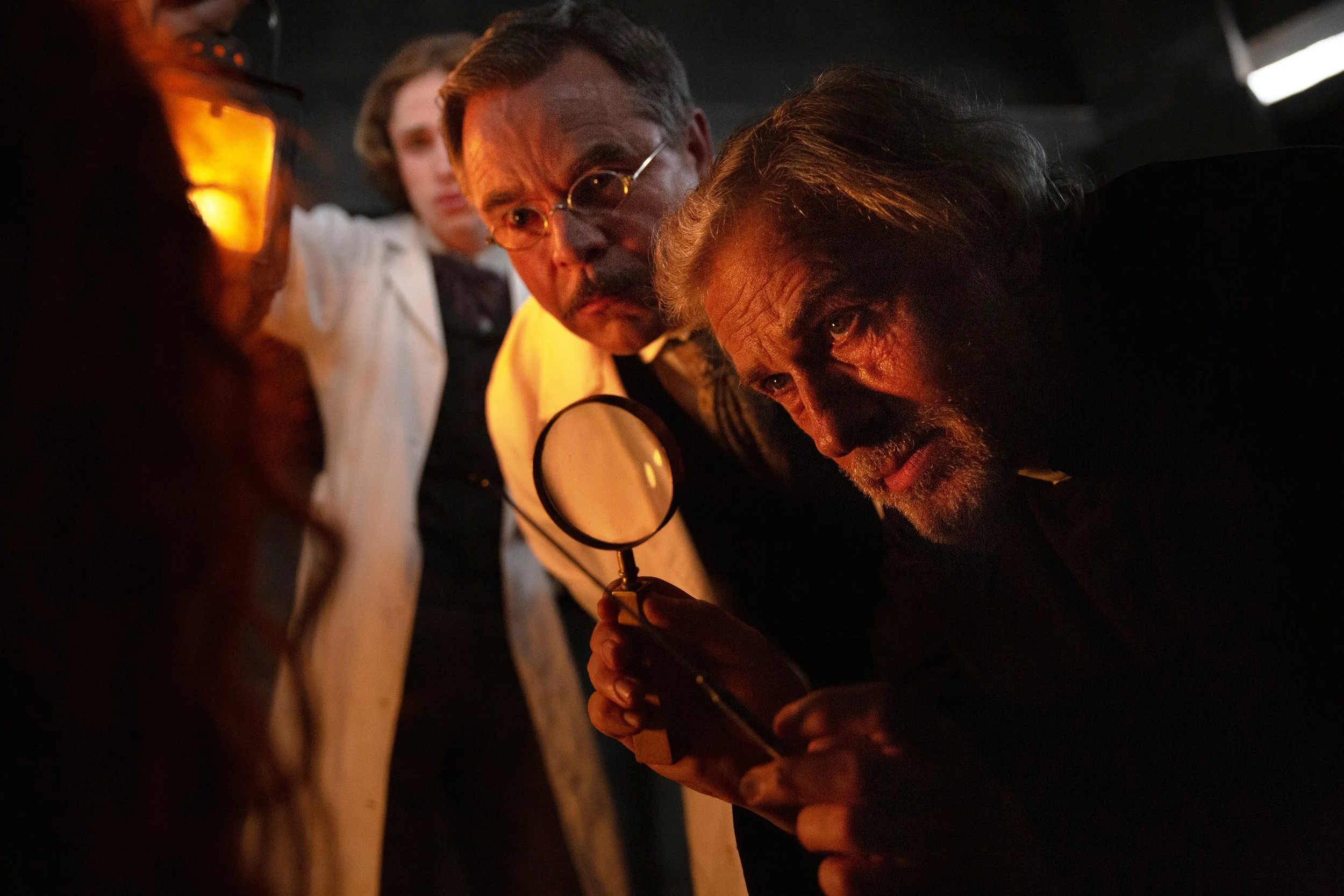
The Priest (Christoph Waltz) on the trail of you-know-who
Cursed to centuries of loneliness, he uses a specialized perfume to lure women while searching for her reincarnation, eventually finding her in modern-day Paris as Mina (Zoë Bleu), the fiancée of his land agent. Waltz’s Priest echoes the Van Helsing of popular portrayal, save for his mission to bring the vampire back to God and redemption.
Bonnie Laufer spoke with Waltz about reimagining a legendary story and what drew him to this haunting new vision.
Dracula opens in theatres on February 6th.
CLICK HERE to read John Kirk’s review of Dracula.
CLICK HERE to watch Bonnie’s interview with director Luc Besson and HERE to catch her interview with stars Caleb Landry Jones and Zoë Bleu.

ORIGINAL-CIN: I have to say Christoph, I was really taken by this movie, I really loved it.
CHRISTOPH WALTZ: Me too! I think it turned out quite well.
O-C: I am now team Drac! Who doesn't love a guy who waits 400 years to find the love of his life? I know that you've read Bram Stoker’s Dracula, but when Luc presented the script to you with this love story angle, I can’t imagine there was much hesitation on your part.
WALTZ: Well, to a degree but you know, when Luc Besson comes and utters the word Dracula, you expect something that is a little beyond the regular.
O-C: Absolutely, I would think that he wouldn’t have done this without a different twist to it.
WALTZ: Exactly. By the way, I don't really like the (Bram Stoker) novel at all. Yes, it’s a historical perspective set in the Victorian era and it's very interesting to learn about Victorian mores. But the whole Victorian era and the rise, or rather, the taking over of the human spirit by petty bourgeoisie - which is the Victorians to me - is not inspiring for me.
So I find the novel Dracula terribly stodgy and stuffy. I'm not a cultural historian, so Luc’s approach exploded that theory and it's exactly the opposite.

O-C: He really made us feel for Dracula in a way we’ve never been presented before.
WALTZ: There's a very deep philosophical core in that, in Luc’s approach of someone who derives entitlement and justification for actually pretty extreme actions from his love, or what he perceives as love, and I find that interesting. I find that very concurrent with what we can observe in society today.
O-C: You play The Priest, who I have to say is pretty calm for the task that he has at hand! He also infuses some humour that I found quite comforting. How on earth did you get into his mindset to play him with such ease and calm?
WALTZ: Well, you need one adult in the room, right? (Laughs). If everybody just gives in to their momentary desires and excitement, look what it gets us.
You have to remain calm, cool and collected when you are chasing a vampire. You need someone who has a plan, who understands where it's coming from and where it most likely will go. And you know, someone with an educated approach to find equilibrium that makes continuation possible.
I also liked that he had a sense of humour, I mean you have to, right?
O-C: We've seen you this year in Guillermo Del Toro’s Frankenstein. Now you are in Dracula. I have to know, is the Wolf Man next? What's with you and these classic monster movies?
WALTZ: (Laughs) I wish. I was really trying to get a third (misunderstood monster movie), but there was nothing available. In all honesty it was an ironic coincidence, really. There was no plan behind it. But if anyone is listening, I am open to another one!