
A Magnificent Life: Animated Take on French Film Giant Marcel Pagnol Loses Something in Translation
By Karen Gordon
Rating: B
French writer-director Sylvain Chomet takes a unique and romantic approach to the life of the great French writer-director Marcel Pagnol in A Magnificent Life.
Chomet, who has helmed Oscar nominated animated films The Triplets of Belleville and The illusionist explores the legendary Pagnol’s life and work in yet another animated film, with mixed results.
For his part, Pagnol is a legendary 20th figure in France, a driven creative whirlwind: a playwright turned pioneering filmmaker, producer and novelist. Audiences outside of France might know him as the author of the book and film that inspired two internationally popular films in the 1980s, Jean De Florette and Manon of the Spring, both directed by Claude Berri.
The film begins in the early 70’s when Pagnol, who has already had a long, successful multifaceted career in the arts, is despairing of the relevance of it all to friends, one of whom is the editor of Elle Magazine.
“Nonsense!” she says. She hires him on the spot to write a serialized autobiography of his life, something that would allow him to tell the story of the things that have been important to him. These include his love for his childhood home in Provence, and in particular his beloved Marseilles, as well as the kinds of characters he grew up with, and their distinctive way of speaking, which he has felt is important to capture.

Pagnol accepts the assignment, but can’t do much with it. He’s stumped and seems to feel creatively depleted. But right at his deadline, he gets help: a visit from a ghost! It is the ghost of himself as a boy, who in a sense helps, allowing the adult Pagnol’s thoughts to flow again, to travel back to key moments in time.
That starts in his boyhood and a memory of conversation with his grandfather who urges him to do work that is meaningful. “All that is beautiful is true,” his grandfather tells him, ”And all that is true has earned the respect of the Divine.”
These words plant something in the young Pagnol that seem to form the basis of his attitude to the work that is to follow.
The film follows Pagnol through various points in his life. He moves from a young boy grieving the loss of his beloved mother, who, at points in the film, shows up as a ghostly figure alongside his boyhood self, to a schoolteacher who takes an opportunity to move to Paris with his first wife, where he gets involved with a group of artists.
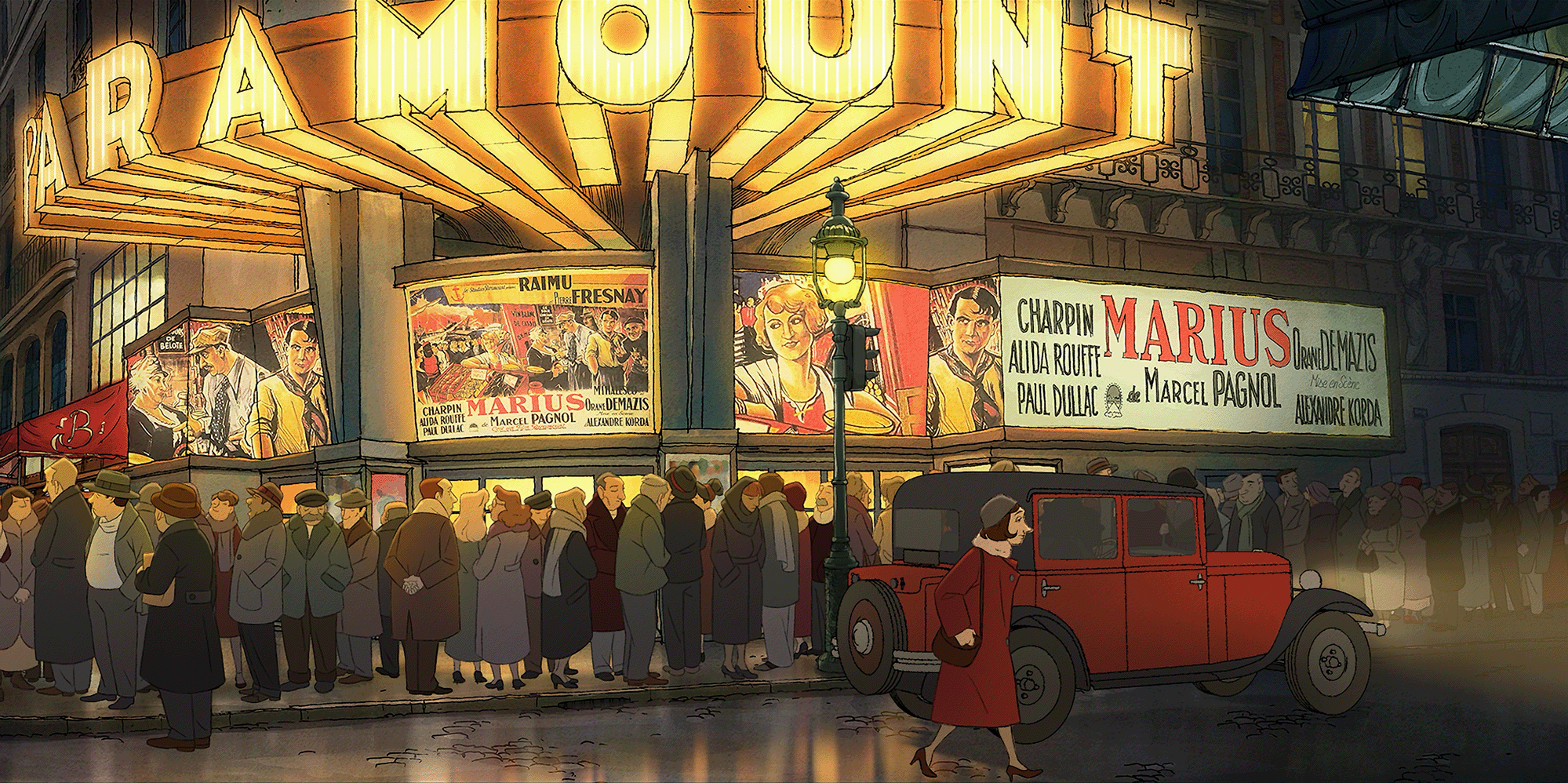
He becomes a playwright. And that success, and what seems like an inner compass that won’t let him keep repeating his successes, propels him forward. Next comes film, and a connection to Paramount Studios, that turned one of his plays into one of France’s first talking films, directed by Alexander Korda.

Inspired, Pagnol founds his own production company and then his own film studio in Marseilles, to produce and direct his own films.
The film follows his personal life, his lifelong obsession with trying to invent a perpetual motion machine, relationships, and family struggles, including the tragic death of his beloved young daughter Estelle at the age of three.
A Magnificent Life was originally intended to be a documentary. The idea came to Chomet by a group of producers - including Pagnol’s grandson Nicholas - who initially wanted to include some animated sequences. But through the development process, it morphed into a completely animated film.
It is an interesting choice for a few reasons. Where a documentary would tell us how the artist reacted to various moments in his life, the animation allows Chomet to turn Pagnol into a character, putting words and emotions into the character's mouth. It allows us to see his reactions.
In theory this would bring more of intimate or personal tone to the film, making him less of an icon of French culture and more of a human being wrangling with issues, both in his personal and professional lives.
And we do get a sense of certain aspects of his life. Pagnol seems like someone who wasn't content to rest on his successes, even as they accumulated. What we see in this film is that these things didn't bring him a lot of personal peace or contentment. We see a man plagued with anxieties and insecurities.
The problem here is that the film doesn’t transcend the animation. We can see the character’s angst, happiness and sorrow, but it doesn’t cut through. The film’s emotional life doesn’t quite connect and feels remote.
It’s a similar issue with the work itself. There isn’t enough context to help us understand the work, and where its inspiration came from.
Still, the film does capture Pagnol an artist whose commitment to his personal vision and seeming desire to live by the words of his grandfather, kept him moving, looking for what was true.
A Magnificent Life. Directed by Sylvain Chomet. Featuring the voices of Matthew Gravelle, Lu Corfield, Jonathan Keeble, Celyn Jones, Jess Nesling, and Flora Montgomery. In theatres, March 27.