
Two Prosecutors: A Whistleblower Takes on Stalin’s State Machine
By Liam Lacey
Rating: A
Berlin-based Ukrainian director Sergei Loznitsa specializes in shining a light on Russian tyranny past and present in both documentaries (Maidan, The Invasion) and fictional films (My Joy, In the Fog).
His latest Two Prosecutors is set in 1937 during Stalin’s “great purge” of his Communist party enemies, and a year before the arrest of author Georgy Demidov, who spent 14 years in the gulag and on whose novella the film is based.
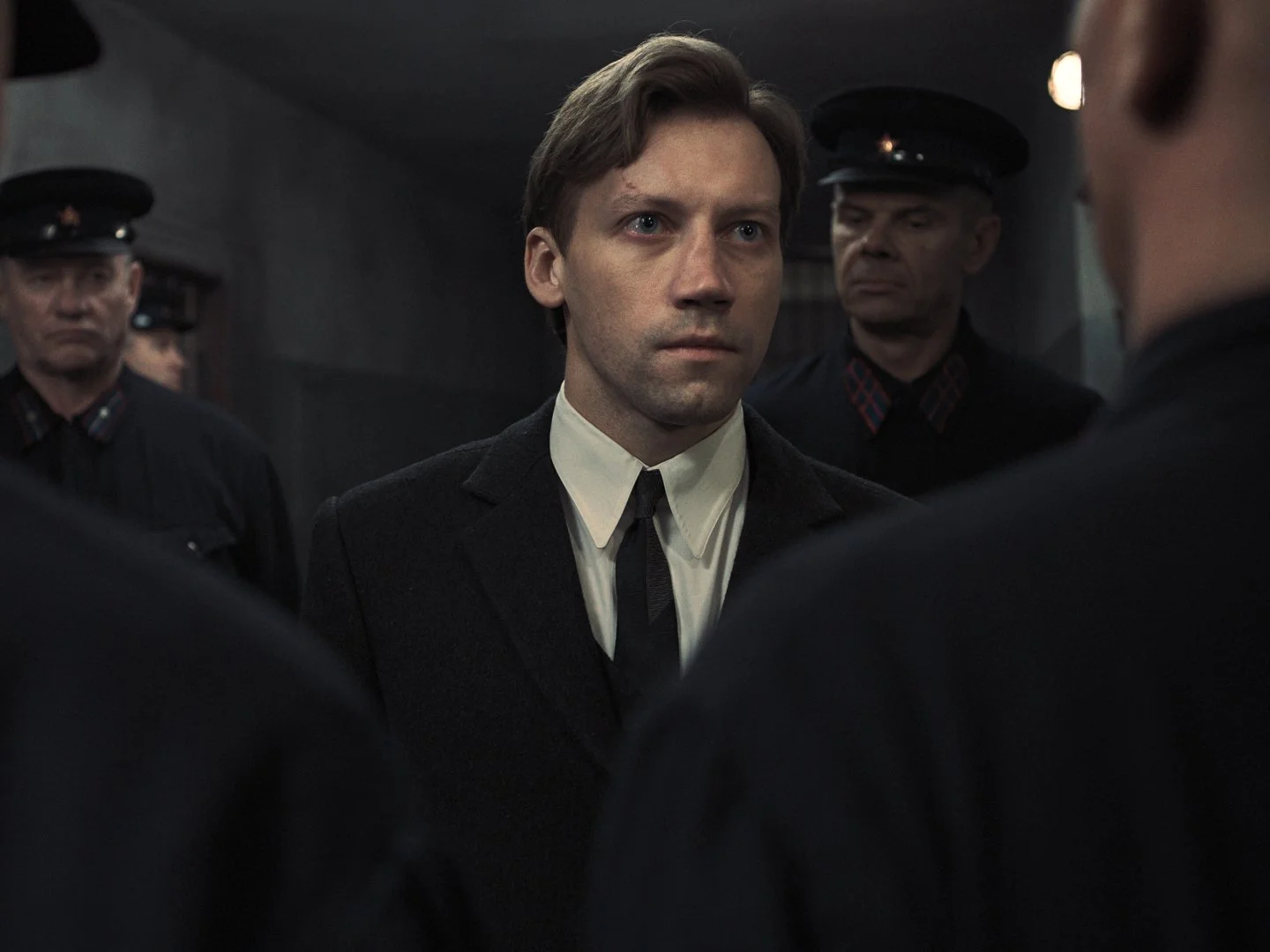
In an opening sequence, uniformed prison guards push an elderly man into a cell, which contains a small stove, a book of matches, and a sack of letters. The letters are addressed to Comrade Stalin from prisoners protesting their innocence and begging for clemency.
The rest of the film follows the first of the two prosecutors of the title, an idealistic recent law school graduate Kornev (Aleksandr Kuznetsov), who is working for the prosecutors’ office.
One letter, written in blood, has made its way from the Bryansk prison in southwest Russia. Kornev sets out to interview the inmate and investigate the claims. The prison officers delay and make excuses, before agreeing to let him see the inmate, old-school socialist, Stepniak (Aleksandr Filippenko).

Kornev recognizes him as an esteemed speaker at his law school. In a long scene, Stepniak recounts his persecution and physical abuse, raising his trouser leg to reveal his bloodied and scarred shins.
By the time Kornev exits the prison gates, the young lawyer is convinced he has stumbled on a local counterrevolutionary plot led by the NKVD (secret police). Determined to stamp out this budding emergency, he takes the train to Moscow to bring the matter to the attention of Stalin’s chief prosecutor.
En route, he falls asleep in a crowded train car while a garrulous war veteran (played by the same actor as the old Bolshevik) regales the sleepy passengers with a story of how he once travelled to St. Petersburg to ask for alms from Lenin and is now on his way to Moscow to do the same with Stalin.

Finally, Kornev arrives at the building where the chief prosecutor operates. The warren of offices and hallways is a mirror image of the prison, adding to the pervasive sense that this is less dramatized history than darkly absurdist fable suggesting various literary antecedents such as Gogol, Dostoevsky, and Kafka.
The filmmaking, shot by Oleg Mutu (4 Months, 3 Weeks and 2 Days), emphasizes repetition and confinement, in long scenes with a fixed camera and a boxy Academy aspect ratio.
After repeated delays, so exasperating they are borderline comic, Kornev finally gets a few minutes to present his case to the chief prosecutor Vyshynsky (Anatoliy Beliy), who listens with tight-lipped skepticism, before ordering Kornev to return to Bryansk to gather more documentation for an investigation.
The film’s final act sees Kornev heading back, sharing his train compartment with two gregarious strangers who sing a song and ply him with wine until he falls asleep. Historical hindsight lets us predict where this kind of train ride inevitably ends.
In an early scene, the old Bolshevik prisoner complains not just about the cruel injustice of tyranny, but the stupidity of a system where “knowledgeable experts are replaced by ignorant charlatans.” The first thought is, “Aha, Donald Trump!” but really, any corrupt aspiring autocrat will fill the bill.
Two Prosecutors. Written and directed by Sergei Loznitsa, based on the novella by Georgy Demidov. Starring Aleksandr Kuznetsov, Anatoliy Beliy, Andris Keišs, and Vytautas Kaniušonis. Opens at Toronto’s TIFF Lightbox March 27 with director Sergei Loznitsa in attendance March 28. Opens March 27 at Montréal’s Cinéma Moderne and April 3 at Vancouver’s VIFF Centre-Van City and Ottawa’s Bytowne Cinema.