
Blue Heron: Sophy Romvari’s Audacious Journey Down the Pathways of Memory
By Liam Lacey
Rating: A+
After being awarded the best debut feature at Locarno and best Canadian feature of 2025 by the Toronto Film Critics Association, Sophy Romvari’s debut feature film, Blue Heron, has been on a remarkable roll of positive reviews in major American publications, with several reviewers calling it the best film of the year.
Those reviews set imposing expectations for what is a low-budget experimental film with an unknown cast. My advice (and what is a review except advice?) is to see the film, but blot out the puffy accolades (“exalted”, “exquisite”, “shattering” and the always dubious “gut-punching”).
This is a film best experienced directly, watched closely with few preconceptions, and though it may inevitably stir up parallels to personal experiences, it does not mean you are stone-hearted if you are not actually devastated.
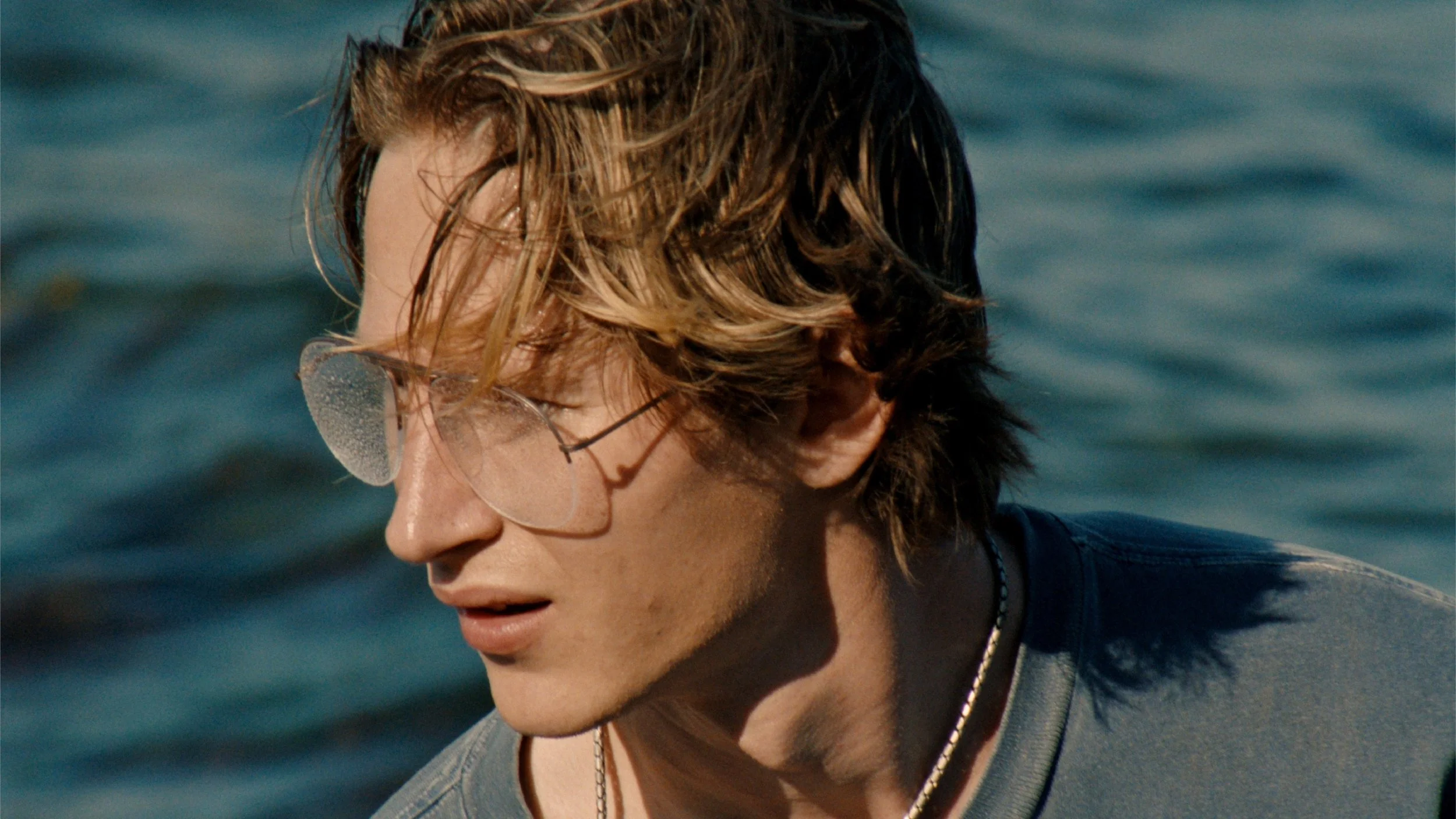
Edik Beddoes as the troubled Jeremy in Blue Heron.
The story, which is partly set in the late ‘90s, is about a Hungarian immigrant family who have recently moved to Vancouver Island, and their struggles with their deeply troubled adolescent son, Jeremy (Edik Beddoes). “I struggle to remember much of my childhood,” says a female narrator at the film’s introduction.
Romvari, who has spent a decade making an acclaimed series of short films, explored the non-fiction version of her family’s painful history in her 2020 documentary short, Still Processing(streaming on the Criterion Channel). That film was part of her master’s thesis at York University, offering film as a therapeutic tool to deal with grief.
Blue Heron shares much of that personal story. But what makes this painful subject bearable, even aesthetically pleasurable, is the film’s formal ingenuity. How do you tell a family story from the perspective of a sibling, of uncertain memories and partial understanding? Through fictional reconstruction? Through documentary? Through the imagination? How about all three?
Though I am sure there will be many more family memory films, Blue Heron sets the bar at a new level.

We begin with the perspective from Jeremy’s eight-year-old sister, Sasha (Eylul Guven). The family includes her parents (Iringó Réti and Ádám Tompa), Sasha’s has two slightly older brothers Henry and Felix (Liam Serg and Preston Drabble) and the eldest, Jeremy (Edik Beddoes) from the mother’s previous relationship.
The film starts during a summer in the 1990s, when the family has recently moved from a nearby island to a house in a Vancouver Island, with its grand mountains and seascapes.
In their small suburban home, Dad does some sort of work on his computer and photographs or videotapes the family a lot.
Mother takes the kids out of the house to keep them out of his way. One day, she takes them to a nearby nature center where they hear about herons of the title. Sasha sees Jeremy steal a souvenir of a blue heron key ring, which in a sweet moment, he passes to his sister.
The first half of the film consists of a series of progressively more disturbing incidents involving Jeremy, a lanky blond teen with large glasses, few words and tightly contained intensity. At first, this looks like moody teenager behaviour. On a family trip, he deliberately gets lost. He hassles his brothers at breakfast.
Then things begin to get strange. One day, he lies down across the steps of the front porch; a panicked neighbour calls, thinking he has died. He makes a mess of the kitchen, bangs a basketball against the house repeatedly, climbs on the roof. He comes home by the police in handcuffs after being caught shoplifting.
Sasha hears things, worried conversations through closed doors while a set plays in the background. We see how anxiety about Jeremy’s erratic behaviour reverberates through the family. The mother says Sasha should not bring her school friends home. Sasha, who falls onto a swimming pool tarp and nearly drowns, instinctively lies to her father about how she got wet. She knows the parents don’t need any more stress.
Cinematographer Maya Bankovic shoots the film in long takes, often distantly with a telephoto lens, or isolating characters in the frame. Sometimes the point of view is clearly that of Sasha’s. At other times, it feels like the family is being studied by an outside observer, scrutinizing the family (there are no extras in the film) both in happy, mundane and critical moments.
Who is that implicit observer? A little past the halfway point in the film, the mother makes a phone call, speaking to another woman about Jeremy’s case. She is speaking on a dial phone. The woman with the dark curly hair on the other end is on a smart phone. Here’s where the film takes what editor Kurt Walker has called its first “big swing.” We have jumped ahead to the present day.
The tension eases and the film shooting style becomes more conventional. The woman, we come to understand, is the adult Sasha (Amy Zimmer), a documentary filmmaker investigating the history of her late brother, checking them against her own childhood memories.
In the film, Sasha assembles a group of real-life social workers to review Jeremy’s case file for, among other things, the decision to put him into foster care.
Zimmer, whose previous experience was primarily in New York alternative comedy, was cast in the film partly because of her improvisational skills in the verité scenes. That may be why her performance, in the best sense, does not feel like “acting” at all, but responses that arise in the moment.
Documentary and fiction meld in a scene between Sasha and social worker, Bonnie Murell, who reveals that Jeremy’s behaviour was much more chaotic and disturbing than Sasha’s childhood memories.
In the third act, Blue Heron takes its second “big swing,” as Sasha imagines herself as a social worker traveling back in time to be with her family, a messenger from the future bearing hard truths and tender wishes.
CLICK HERE to watch the video of Bonnie Laufer’s interview with Blue Heron director Sophy Romvari.
Blue Heron. Directed and written by Sophy Romvari. Starring: Eylul Guven, Inringó Réti, Adám Tompa, Edik Beddoes, Amy Zimmer, Liam Serg, Preston Drabble.
Blue Heron opens in Toronto on April 24 at the Cineplex Varsity and VIP with an April 24 post-screening Q&A with director Sophy Romvari and David Cronenberg, May 1, at Montreal’s Cinema Moderne with Sophy Romvari in attendance, May 8, at Vancouver’s VIFF Centre and across the Canada through May.