
Original-Cin at Cannes: Ten Films Seen Amid Well-Organized Madness
By Carol J. Bream
CANNES, France, May 18, 2026 – A first-time attendee at the Cannes Film Festival finds magical experiences, a mixed-bag of films and constant wonderment at the unlimited human imagination on display here on the French Riviera.
Being at this festival is an amazing experience; there are so many films to see, press conferences to attend, and special events at which the stars are present, either in the theatres or on the red carpet.
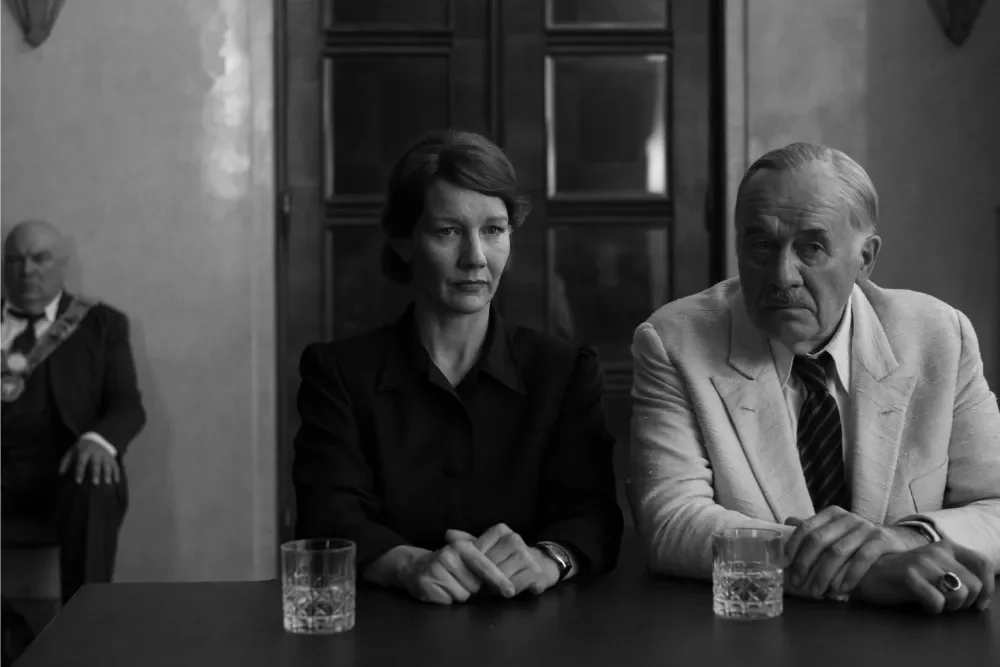
Sandra Hüller and Hanns Zischler in the Thomas Mann tale Fatherland
Arriving in Cannes a few days in advance of the fest’s official start, you might think things were almost normal in this exquisite jewel of a city by the sea. But by the second day, the streets teem with humanity from around the world, with the French national police force, the CRS, much in evidence everywhere around the city’s seaside boulevard, La Croisette. Since the Bataclan attacks in Paris in November 2015, security for big international events has been tightened in Cannes. Our handbags and backpacks are searched every time we go in or out of Le Palais des Festivals, where the films are screened.
The supremely well-organized festival has thousands of staff members to direct movie goers. The staff are paid, well-trained and unfailingly polite and helpful, even as ticket holders swarm into the various lines to enter the many Palais theatres. The festival is a spectacular economic boon for Cannes, too, with shops, bars and restaurants full to overflowing.
Over the course of the first five days, I’ve seen 10 films:
· Pan’s Labyrinth (Cannes Classics)
· The Electric Kiss (Opening Film – Out of Competition)
· Nagi Notes (Official Competition)
· A Woman’s Life (Official Competition)
· Fatherland (Official Competition)
· Parallel Tales (Official Competition)
· Tangles (Special Screenings)
· Teenage Sex and Death at Camp Miasma (Un Certain Regard)
· Propeller One-Way Night Coach (Cannes Première)
· John Lennon: The Last Interview (Special Showings)

Pan’s Labyrinth was presented by celebrated director Guillermo del Toro in a newly restored version of his 2006 fantasy film. He was accompanied by the film’s Spanish star, Ivana Baquero, who played the role of Ofelia when she was just 11. Del Toro, who was nominated for the Palme d’Or for Pan’s Labyrinth, is a master of human creativity. The film’s arc combines Franco-era fascism and cruelty with a dark fairy tale translated via exceptional costumes and makeup design.
Before the screening, Del Toro spoke movingly of the meaning of film and art in his life and the importance of “leaving a mark,” and the choice between giving “into love or to fear…but never fear.”
After the screening, he spoke again to thunderous applause that continued nearly as long as the record-breaking 23-minute ovation he received in 2006. “Film and art have saved my life many times,” he said. “And F**K AI!” His latter comment got instant audience reaction and more sustained applause.
The Electric Kiss begins in Saint-Ouen’s flea market in 1920s Paris, where a barker cons men into paying for a magical kiss from the beautiful Suzanne. Behind the curtain, electric switches connect to two metal orbs onstage, ensuring the men get a real shock when they kiss Suzanne.
Along comes Antoine, a handsome but despairing young painter (Pio Marmaï). After the kiss, he tries to contact his recently dead wife through a fraudulent medium and begins painting once again to the delight of his smarmy gallery agent. After many sessions with the “medium,” paid for and in connivance with the agent, Suzanne starts to fall in love with Antoine. Several twists and turns later, the two are united in love. It’s quite the fun deception, with a finale that nods to Romeo and Juliet.
Nagi Notes is a subtle (and sometimes glacially moving) reflection on art, memory and family in Nagi, Japan, a bucolic town whose tranquility is often interrupted by sounds from the nearby military target range.
The blasts hint at fractures in Nagi life: two adolescent boys declaring their love to outsider Yuri that they cannot reveal to their parents. The film centres on two former sisters-in-law, Tokyo architect Yuri and sculptor Yoriko, who reunite after a lengthy estrangement. The destruction of a not-quite-perfect bust that Yoriko has made of Yuri speaks to the disquiet in all their lives. As gentle as it is slow moving, this film by Kôji Fukada won’t be everyone’s cup of tea.
A Woman’s Life eloquently reveals the struggles of Gabrielle, a leading female surgeon at a public hospital in Paris, as she attempts to balance her professional life, her complicated family situation, as well as old and new friends.
Director Charline Bourgeois-Tacquet takes us through Gabrielle’s daily hospital crises, problems with her aging mother, her strained marriage, and a new infatuation with an equally driven female novelist. Léa Drucker as Gabrielle is convincing as she snaps at her husband and has difficulty accepting a younger surgeon’s desire to have a normal family life. Every A-type woman I spoke with about this film could relate.
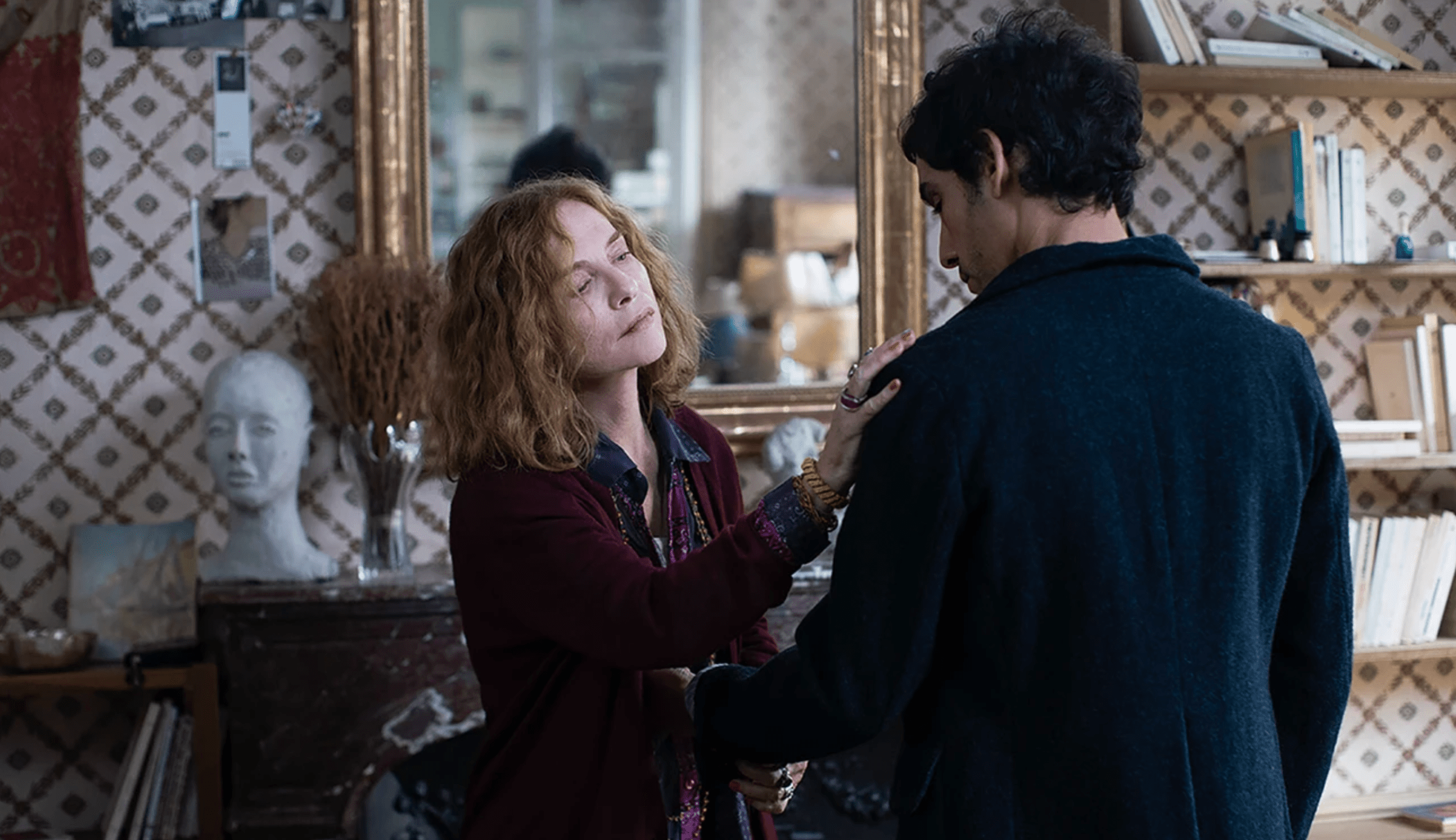
Isabelle Huppert and Adam Bessa in Asghar Farhadi’s Parallel Tales
Fatherland depicts Nobelist Thomas Mann’s first return to Germany after the Second World War. After a speaking tour in Frankfurt, events take Mann (Hanns Zischler) and his daughter, Erika (Sandra Hüller, always a marvel), into fraught situations, including border crossing for a lecture in Weimar in then-East Germany.
An encounter between Erika and her ex-husband, an actor who stayed in Nazi Germany, ends in her giving him a hard slap on the face. In another scene, Mann meets Richard Wagner’s grandsons, who want him to support a new festival at Bayreuth, Bavaria. The request elicits a hateful blast from Mann: “They should bomb Bayreuth.” (Mann had gone into exile in California rather than support the Hitler regime.)
The film, brilliantly shot in crisp black and white, culminates in an emotional return to the family’s now empty and damaged former church, where the organist plays J. S. Bach’s Jesu, Joy of Man’s Desiring. Fatherland, from director Pawel Pawlikowski is a must see.
Parallel Tales, by celebrated Iranian director Asghar Farhadi, is a mishmash of people spying on each other in strange and unsettling ways. Isabelle Huppert stars as Sylvie, a fading novelist who takes in a homeless man who stalks one woman and then another.
In different apartments across the street from her own, Huppert’s character trains her telescope on a dark-haired woman whom she thinks may be related to her, and then on three people in a sound effects studio on the same floor.
It all gets too complicated. The film’s best scene is between two powerhouses of French film: Huppert and Catherine Deneuve, playing Sylvie’s long-time editor, who asks the writer to rethink her entire new novel.
Judging by the too many tales in this film, Farhadi is more successful at portraying turmoil in his homeland than he is depicting more mundane events in contemporary Paris.
Tangles, Vancouver director Leah Nelson’s first film, is an animated feature based on Sarah Leavitt’s graphic novel. Sarah is living in San Francisco and working with a group of queer artists at a magazine. She returns to her conservative Maine town to help take care of her mother’s faltering health and to help family members accept its stark reality.
Showing the decline of Sarah’s mother into full-blown Alzheimer’s and its effects on the family, Tangles cuts close for many of us. Seth Rogen (one of the film’s producers) plays the off-base fiancé of one of the sisters but redeems himself with his off-key tribute to his new mother-in-law at the wedding.
The cast of voice artists brings in some powerful Hollywood folks — Julia Louis-Dreyfus as the mother, Bryan Cranston as the father, along with Pamela Adlon, Beanie Feldstein, Sarah Silverman, Wanda Sykes and Bowen Yang. Worth seeing to guess which star is doing which voice-over.
Teenage Sex and Death at Camp Miasma, directed and written by Jane Schoenbrun, is an almost indescribable mélange of weirdness and hilarity. It stars Hannah Einbinder and Gillian Anderson, with a host of other well-known actors, including Sarah Sherman (SNL), Patrick Fischler and Dylan Baker.
The title refers to a fictional series of Camp Miasma slasher films, the latest of which draws in a queer filmmaker to do a sequel. It turns into a psychosexual romp, with Jack Haven as Little Death, the blood-spewing ghostly slasher.
The funniest scene is a Zoom call between the filmmaker and her producers, in which she tears off her clothes in an orgasmic frenzy, evoking much audience laughter. Not for everyone but done in such a totally tongue-in-every-cheek approach that the gore isn’t even vaguely frightening.
Propeller One-Way Night Coach is a family adventure film by John Travolta, an avid pilot himself and now the winner of an honorary Palme d’Or. (Please see separate story).
John Lennon: The Last Interview, by Steven Soderbergh, is a deeply emotional and personally revealing interview of Lennon and Yoko Ono by three prominent radio interviewers at the couple’s Dakota apartment in Manhattan in the hours before Lennon’s murder in New York on December 8, 1980.
Lennon and Ono were about to go on tour after a five-year hiatus to promote their Double Fantasy album. The combination of Lennon’s voice and archival photos and footage has a powerful impact. A must-see for any Beatles fan.
Carol J. Bream is a writer living in Gatineau, Quebec, and a former Director of Communications at the Canada Council for the Arts. She is filing reports from Cannes for Original-Cin.