
Twenty-Four Films Later, My First Cannes Festival Ends on an Emotional High
By Carol J. Bream
CANNES, France — My 11 days at the 2026 Cannes Film Festival were exhilarating and, at times, exhausting. I saw 24 films, including the Palme d’Or winner Fjord, and the Grand Prix champion, Minotaur, which I wrote about in a previous dispatch.
That’s a lot of art to absorb. Whether you love a film or remain in your seat to watch the ending in hopes it will change your mind, there’s nothing quite like the Cannes experience.

A scene from Pedro Almodóvar’s Amarga Navidad
This year, Hollywood largely skipped Cannes and, bombarded this weekend by announcements of summer blockbusters, I am struck by why “auteur” films at Cannes (and in local theatres) move me so. The films I saw touched me on many levels, forcing (or allowing) me to live through events and situations both imagined and historical.
Just being able to attend screenings with other film buffs and professionals lends depth and feeling to the Cannes experience. I rarely tear up either in real life or theatres, but I did shed a few tears at Cannes and felt rage and discomfort at what some films portrayed. But my main emotion was joy at being part of this international gathering and the conversations I had with seatmates from around the world.
Five films complete my dispatches from my first Cannes festival, which ran from May 12 through 23.
La Bola Negra (The Black Ball) A Spanish film by Javier Calvo and Javier Ambrossi is inspired by an unfinished work by Federico García Lorca and a screenplay by the two directors and Alberto Conejero. In the Official Competition, it won Best Director for the two Javiers and vied for the Queer Palm.
Lorca was assassinated by Franco-era fascist forces in 1936. In this film, he has left an unfinished work whose fate remains unknown for many years. The film explores the inter-connected lives of three gay men, and the title black ball symbolizes the outcast status of gay men in the 1920s and 1930s, contrasted with the more accepting general attitude in 2017, when we see one of the men, the partially successful playwright Alberto, in Madrid.
The other two men are 1930s-era trumpeter and reluctant soldier Sebastian, and floppy-haired Carlos (in the 1920s), who as a baby was pale as snow. Only the bearded, long-haired Alberto seems to have achieved a sexual relationship; the other men’s relationships were suggested but not overtly realized, perhaps because they took place when such encounters were hidden and socially taboo.
The film is visually beautiful but disconnected at times, jumping between wartime and the present. Penélope Cruz makes a boffo appearance as a cabaret singer to a full house of boisterous soldiers. Glenn Close appears near the end of the film as a fluent Spanish-speaking American author and expert on Lorca, always searching for the rest of his unfinished work.
The cinematography is exquisite, particularly in the snow scene and scenes taking place in a military hospital, where illicit romantic attraction is cloaked in darkened tones and hovering hands that never touch the object of attraction. But one’s concentration is challenged to discover how the film’s threads eventually connect.
Notre Salut (A Man of His Time) In September 1940, 40-year-old engineer Henri Marre goes to Vichy, the seat of the government in occupied France, to try to sell his self-published book, Notre Salut.
Marre believes the pre-occupation French government was burdened by the strictures of parliamentary democracy and thus overly bureaucratic and disorganized. His stated goal is to help reform France (somewhat naively, as it turns out), and he attempts to get a position in Maréchal Pétain’s regime. Hoping for the finance ministry, he only lands a post in the ministry dedicated to helping the unemployed find work.
It seems at first as if that’s what’s happening, but it gradually becomes clear that the German occupiers and their French collaborators want to get rid of the “Israelites” and other “undesirables” in the Vichy-controlled part of France. As the situation in his government ministry devolves, Marre is asked to write a negative report on one of his colleagues, who seems less “patriotic” than required, for the head collaborator in Marre’s department. He must also deal unwillingly with an accountant reluctant to alter the books to hide an expense the German occupiers won’t approve of.
Not everyone in Pétain’s Vichy is willing to comply with the moving target of their job requirements. Marre’s troubling moral ambiguity casts doubt on how he will deal with it all.
The factual details of Marre’s time in Vichy are not known, nor are the circumstances surrounding his death, as the only recounting comes from letters between Marre and his wife. The missives were found recently by Henri Marre’s great grandson, the film’s director Emmanuel Marre — who won in the Official Competition for best screenplay — and used to great effect to recreate the years between Henri’s leaving Paris after several business failures and his death.

Amarga Navidad (Bitter Christmas) Famed Spanish director Pedro Almodóvar’s latest colourful tale, an entry in the Official Competition, can be somewhat confusing as it features a story (or rather a film script) within the story. Although it only becomes salient later in the film, sharp-eyed viewers are alerted to Almodóvar’s technique via a line of type that runs across the screen at several points.
Raúl, the character personifying Almodóvar, is a filmmaker who says he only feels alive when filming. Having lost inspiration, Raúl rediscovers his mojo in a story of three female friends going through a difficult holiday season.
One of them, a forty-something ad director, hooks up with a gorgeous and extremely agile male stripper who works by day as a firefighter. He stars in one of her perfume commercials, and they begin a live-in relationship. One of her friends has just separated from her philandering husband and goes to spend the holidays elsewhere with her young son. The third is a suicidal woman who has lost a child in an automobile accident and goes to stay with the first woman for the holidays at a luxurious spa that doesn’t make her any less sad.
Later, we learn the source of Raúl inspiration and the price he pays for using it to get over his writer’s block. This is not the first time Almodóvar has put himself in one of his films (Pain and Glory, for example), and each time we learn something of his life and work, as much as is possible in a film that’s not a biopic.
I watched some of the press conference with Almodóvar and the cast on the screen in the festival’s media centre. To play Raúl, the director chose Leonardo Sbaraglia, an actor who looks strikingly like a younger, handsome version of Almodóvar himself. The film presents an intriguing dilemma for any creator: how far can he go when imitating life in the pursuit of his art?
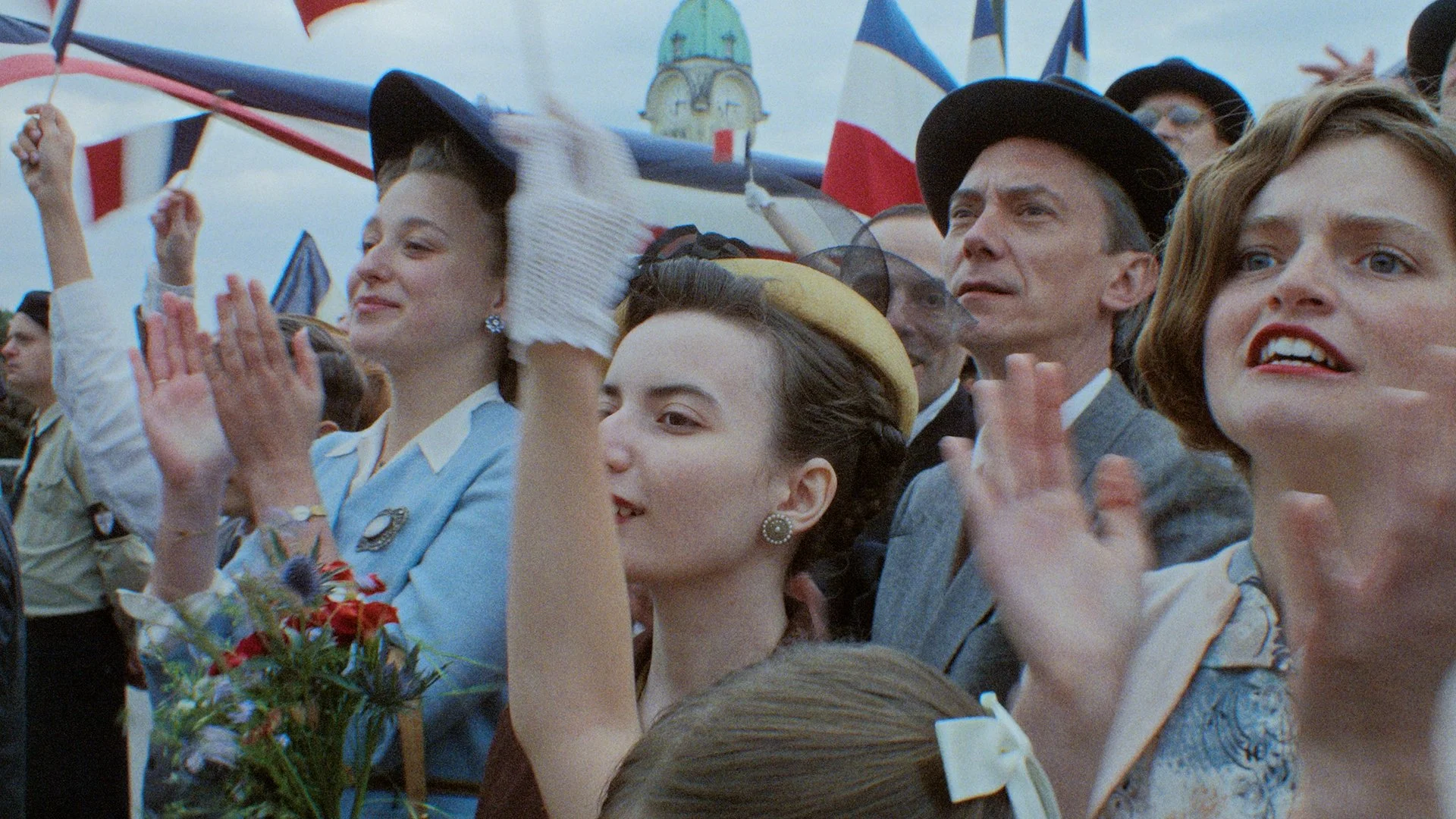
A scene from Notre Salut
La Bataille De Gaulle: L’âge de fer (Tilting Iron) This first part of a two-part biographical epic, directed by Antonin Baudry and co-written with Bérénice Vila, was shown out of competition. The film follows the always controversial Charles de Gaulle during his time as leader in exile of the French Resistance during the Second World War.
De Gaulle rose from being a French army officer to leading the French Resistance against Nazi Germany, to becoming president of France. In Canada, he is remembered controversially for his “Vive le Québec Libre” shout during a visit to Montreal’s Expo ‘67 that July.
De Gaulle’s well-known self-assurance, even arrogance, is on full display here in a masterful portrayal by Simon Abkarian. De Gaulle’s interactions with Churchill and various cabinet ministers as Britain decides how to proceed under extremely difficult wartime conditions — both military and human — are often tense and explosive. The film depicts de Gaulle’s unerring conviction that France would only be subjugated if it allowed itself to be. This is also the message promoted by student activists in Paris and elsewhere, who organize often bloody demonstrations in favour of a free France.
A key side story portrays three friends (Fernand and Jewish siblings Pierre and Livia), who are instrumental in organizing their fellow students against the Vichy regime. Fernand, sent to Algeria to live with his father, remains in solidarity with his friends.
One day he goes to the Algerian HQ of U.S. General Eisenhower, the supreme commander of the Allied Expeditionary Force, thinking that Eisenhower will be welcoming De Gaulle to support the Free France efforts. Instead, Fernand sees Eisenhower warmly greet the Vichy government’s number two official, Admiral François Darlan. Fernand, enraged at what he sees as the United States’ collaboration with Vichy, takes extreme action that leads to catastrophe for him. His Jewish girlfriend, Livia, eventually has a role with the heroic Jean Moulin in the Resistance.
I was particularly interested in the de Gaulle film, having witnessed the 1968 May student riots in Paris and de Gaulle’s re-election as president of France at the end of June. Another turbulent time in la belle France!
Lucy Lost A sweet, animated film directed by Olivier Clert set in a remote farming village on the Isles of Scilly off the Cornish coast of England. It recounts the story of misfit Lucy, whose white hair sets her apart from the villagers. Her parents won’t let her go to school with her brother because of a mysterious fall she had and her frequent visions of people no one else sees, like young Milly, an imaginary friend who appears one day.
At the intrepid Milly’s encouragement, Lucy tames a local farmer’s horse, rides her across the shallow bay and goes to school. There, a nasty boy tries to set the children against Lucy, saying that anyone with white hair is a witch. But, when the school mistress and children hear her play the piano, they are intrigued and curious.
Milly transports Lucy magically to New York, where the two play in the snow in Central Park and get on a ship to find Milly’s war-wounded father, who is in a military hospital in London. The ship is the Lusitania, whose destruction Lucy had seen in a dream. Floating on the ship’s grand piano after the ship is sunk, the girl is rescued by German soldiers, and some of her secrets are revealed. Then, on another boat, she arrives in London to start searching for her wounded father.
Critics and cynics may diss this film, saying it is too sweet, too improbable, but I liked it, and so did a little towheaded boy behind me seated with his press badge–holding parents. How lovely the festival allowed him to get a ticket. The magic of Cannes.
Carol J. Bream is a writer living in Gatineau, Quebec, and a former Director of Communications at the Canada Council for the Arts. She is filing reports from Cannes for Original-Cin.