
The Death of Robin Hood: A Masterful Reimagining of a Familiar Tale
By Karen Gordon
Rating: A
Anchored by a powerful performance by Hugh Jackman, writer-director Michael Sarnoski’s The Death of Robin Hood is an excellent movie that takes a wrecking ball to the conventional story of a popular legend.
The film is based on the accepted story about how the mythic character met his fate. But Sarnoski flips everything on its head. So, forget the green-garbed outlaw hero hiding out in Sherwood Forest with his gang of merry men, robbing from the corrupt nobility of the era to support the oppressed peasants.
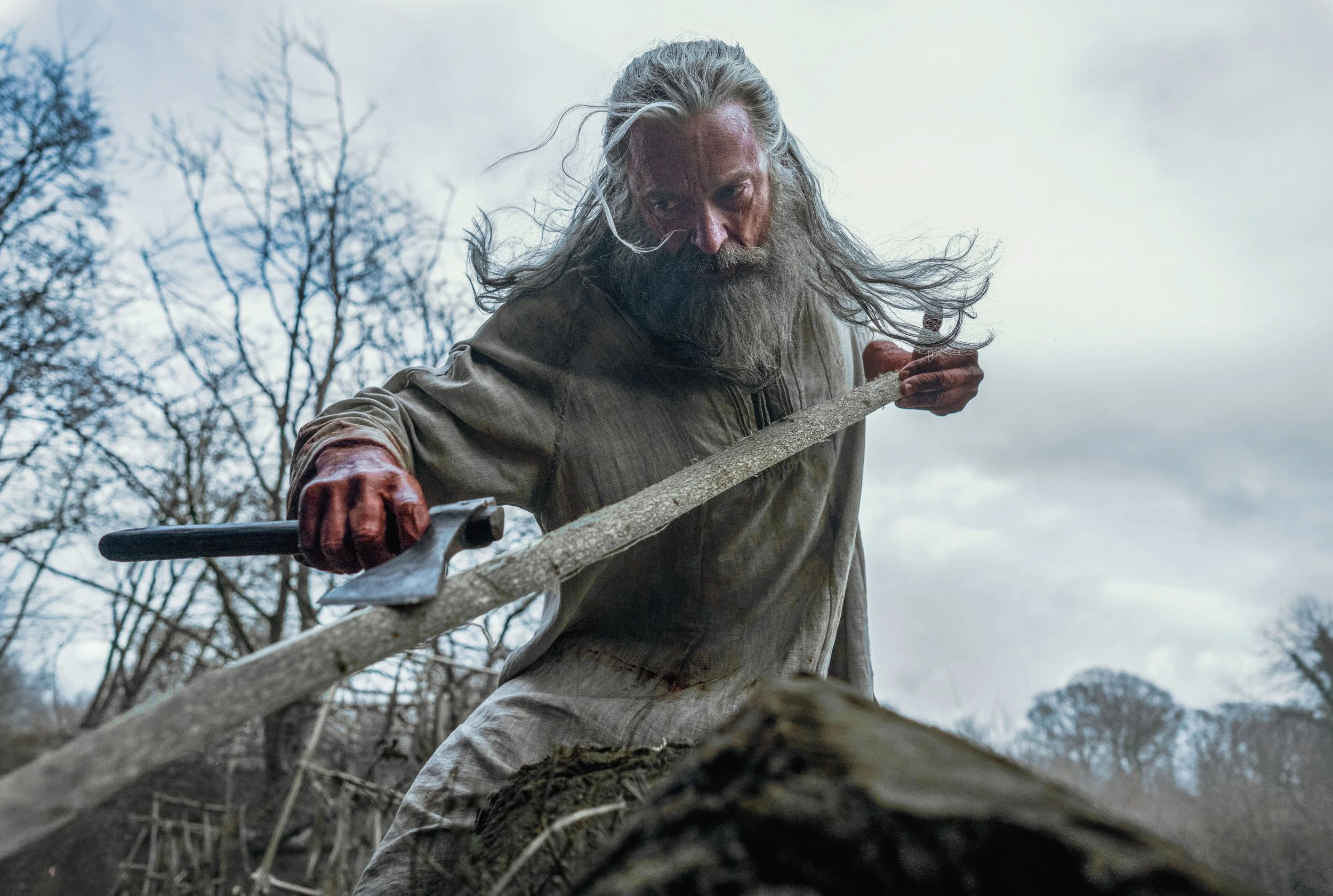
Instead, from the first frame, Sarnoski does everything he can to demolish the myth, putting words in Robin Hood’s mouth, and giving him actions that deconstruct the image of the benevolent man of the people in a most convincing way.
It’s 1247. Robin Hood (Jackman) is living rough in the wild countryside. Was he ever the idealistic “rob from the rich, give to the poor” hero? If he ever was, it was a long time ago, at least in his mind.
Now, he’s isolated, dirty, disheveled, and wary. He has contempt for those who have mythologized his deeds and used them as excuses for others to elevate their offences. He’s not interested in being anyone’s legend. He has neither illusions nor an inflated ego to shield him from who he really believes he has become and always was: a murderer and criminal.
He’s living in increasingly remote places, hiding from people who want to take their vengeance on him for the things he’s done in his past. Families of people he has killed want their revenge in blood are hunting for him.

He’s tired and battered, but tough. Still physically powerful, focused and when unleashed, ferocious and merciless, Robin can't get far enough away to make it stop. He kills without blinking an eye to save himself. But it seems more instinct than a will to survive and thrive.
One of his former gang members, Little John (Bill Sarsgärd) finds him and asks for help to reclaim his family. Robin agrees, leading to a violent confrontation.
The first act of the film is raw and bloody. Sarnoski gives us a series of one-on-one battles, 13th-century style. Witness hard men using crude blunt instruments, knives and fire in their battles. By the end of it, Robin Hood has been gravely injured.
And then things change. That darkness, brutality and blood yields to a sunny, clean place, so quiet that it feels meditative. Robin wakes up days later in a priory, being attended to by Sister Brigid (Jody Comer), a calm, quiet radiant presence.
If the first act felt like Robin Hood in hell, this feels closer to him experiencing a kind of heaven through her grace and benevolence. For reasons we can only guess at, Robin hides his identity and introduces himself to her by a different name.
Sister Brigid runs what is effectively a convalescent home, a community for mostly orphaned children to heal and live. The priory is an old castle or monastery, perched on a cliff overlooking the water.
As Sister Brigid takes care of him, Robin begins to heal and integrate into the community. Sister Brigid gives him jobs to do. Among them, hunting the local rabbits for food.
He’s also assigned to help the only other adult male in the community, a leper and a gentle soul (Murray Bartlett) who tends the priory’s fruit orchards. The leper is completely covered in bandages obscuring his face, and becomes a kind of guide for Robin.
It’s an entirely different kind of life. Sarnoski gives us the beauty of the natural world around them: sunshine, beautiful forests, the wildness of the water below the priory. Slowly, Robin integrates himself into this new, softer world, and becomes a father figure to the community.
And that role becomes sharper when little Margaret (Faith Delaney) arrives, so traumatized by the violence she’s endured that she’s non-verbal and won’t let people near her. Robin knows who she is, and very gently takes her under his wing, and she starts to heal.
After the raging violence of the first act, the film settles into this gentler groove. Robin is a changed man in some ways. There’s a quiet masculine strength about him, a protectiveness and a sense of ease and belonging.
It feels like he’s instinctively filling a void that the community needed and perhaps is filling a void in him that he’s perhaps may not have known was still in him. He’s more thoughtful and in little ways he seems to be at ease with this role. But he has a past and the question of what that means to him in this shift, sits entirely within him.
Sarnoski gives us the story of an intense, quiet man driven inward and matches that with a film that uses visual and environmental cues to underscore that: dark, light, and the natural world as reflections of his inner state.
The darkness, mud and filth of the early scenes, the light of the priory in the sunshine or lit by candles, the crashing waves on the shore, gorgeous to look at and beautifully shot by cinematographer Pat Scola.
The movie is spare in many ways, and so relies on its cast, notably Delaney as little Margaret, and Noah Jupe, as an older boy who is hiding a burden who Robin can see through. But the film leans heavily on the performance of Jackman, who is riveting as Robin Hood. He is simply masterful in an Oscar-calibre performance. He is well matched by Comer, who continues her run of superb work.
Is the film about atonement? Personal reckoning? Forgiveness? Self-compassion? Even without contemplating the various themes (and there are more) The Death of Robin Hood has an internal beauty; the characters and their haunting choices linger.
The Death of Robin Hood. Written and directed by Michael Sarnoski. Starring Hugh Jackman, Jodie Comer, Murray Bartlett, Faith Delaney, and Noah Jupe. In theatres June 19.