
Lars Shrike Walks the Night: When Are Characters People?
By John Kirk
Rating: B+
Here’s the main criticism of Lars Shrike Walks the Night: it’s slow. Really slow.
With that said, the reason for the slow pace is because the level of curiosity inspired by the hapless Lars Shrike — wandering the desert of an alien planet under a green sky — overwhelms the viewer. Carrying only a solar umbrella and armed with a chrono-blaster with an AI personality (Laurie Drayton) rapidly depleting its energy charge, we need to know this character’s back story.
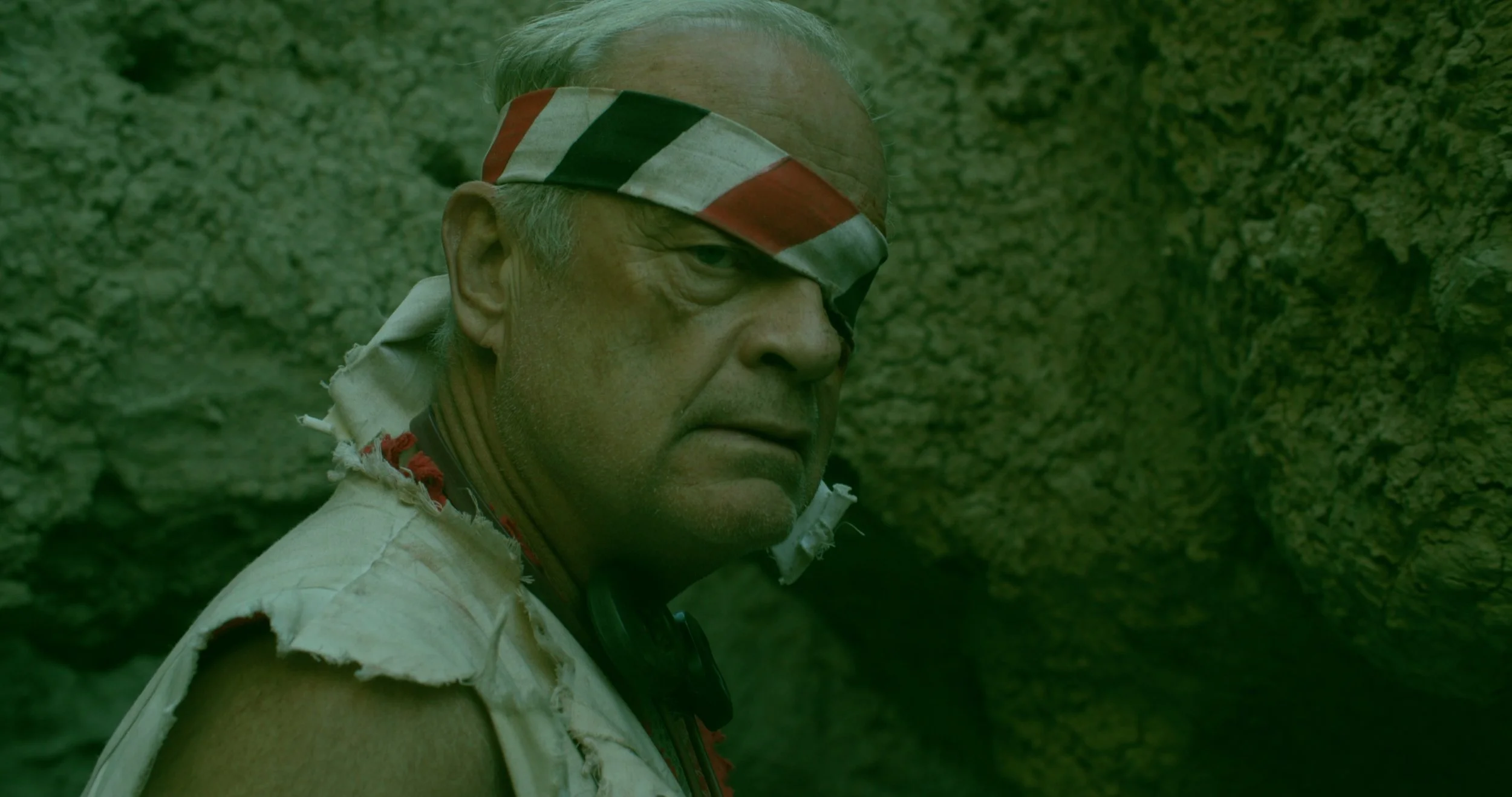
Let it be said that this will not be a mainstream blockbuster success but this is what telling stories in a filmic medium should be. Even though the journey through this story was a slow one, it’s immensely moving and enjoyable.
And here’s the story. Escaped prisoner Lars Shrike wanders through the desert of an alien planet. Tortured by heat, attacked by aggressive alien fauna and suffering from a selective amnesia, Shrike must contend with survival and not knowing who he is. When he passes through a dimensional gateway of sorts that takes him to Earth, his travels inspire more questions than answers.
This film is a deep existential dive that explores the notion of creativity. When do characters in a story escape their fantasy boundaries and cross over into reality?
A character has to be believable. It doesn’t have to be liked but it certainly needs to be accepted as a person with ambitions, desires, a purpose. Lead Kelsey Grammer’s presentation of Lars checks all those boxes.

The success of this film is how invested and curious the audience becomes as we learn more about Lars. His ambition to get off the planet and find a power node where he can recharge his chrono-blaster and signal a transport beam and get off the planet is perfectly acceptable. It’s sci-fi technobabble, of course, but it’s contextual and genre-accurate. It’s easy to understand.
He desires to know more about himself. He discovers he can read. He wonders if he has a family and what was the crime that had him incarcerated. Between Lars’ staving off thirst and predators, it’s easy for the audience to also feel sympathy for him and to share in his curiosity about his background.
Finally, Lars realizes that all these things combine to make him wonder about his purpose. Is his amnesia temporary and will his memory return when he gets off planet? Is he being watched? His immediate purpose is to then escape the planet and hope that things work out.
When he passes through a rock formation and notices that the sky had changed colour from green to blue, it’s apparent his purpose needs to be reassessed.
Earth is a different planet and when all his motivations shift to discovering how he traveled from one planet to another, the audience is firmly ensconced for the ride right along with him.
But there’s more. Apparently, his name is known to people on this planet and through the help of a kindly librarian who takes him for an unhoused person, she helps him with a web search to help find the one person who knows his name.
Lars Shrike Walks the Night is a mystery. But it also is an examination into when a fictional character in a story becomes real. When writers create their characters, they have created other lives and are responsible for their welfare, in a way. That is measured by determining their purposes, motivations and desires. Without them, they suffer and so do the writers.
This is a film of intricate cleverness and Grammer’s performance embodies these questions in a way that shows the suffering of fictional characters who lack these features. When Lars narrates his own observations, he is shocked to discover another voice in his head answers him and dismisses it. The implication is that it is a voice from his incarceration. Maybe a psychologist?
As stated, this sci-fi film is slow-paced but it’s necessary to provide Lars the chance to allow the audience to accompany him on his journey of self-discovery. When we all arrive at the destination together, it’s a journey worthwhile taking.
Lars Shrike Walks the Night. Written and directed by Gary Walkow. Starring Kelsey Grammer, Christine Lin, Bobby Furst, Katie Schwartz, Laurie Drayton and David Clennon. Available on VOD July 24.