
Evil Dead Burn: Evil’s Easy, Family’s Hard
By Thom Ernst
Rating: B-
When a long-running horror franchise starts pushing 40, it’s time for it to start asking the tough questions, like, where do we go from here? For Evil Dead Burn, the answer appears to be simple — make the violence hurt more. Not just gorier but more tactile.
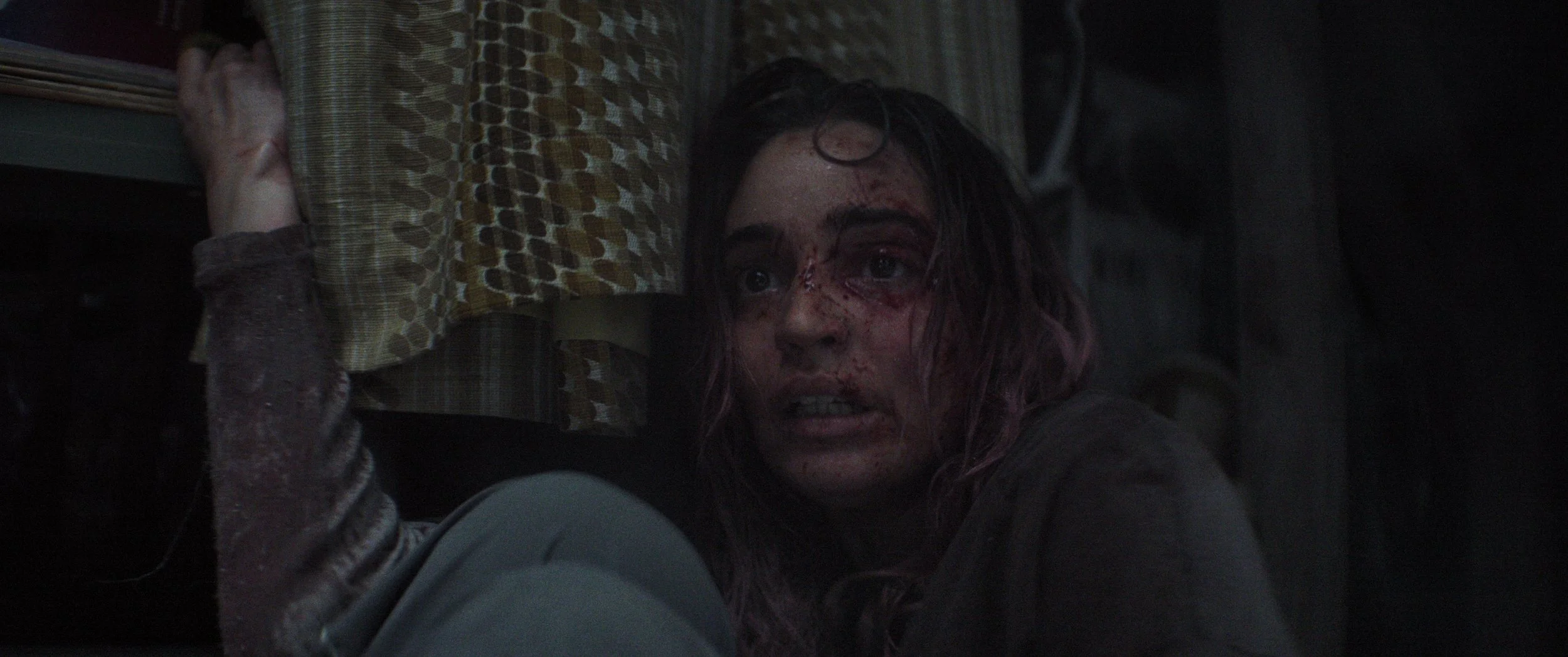
The Evil Dead films have always delighted in outrageous splatter (even the staged musical version has front row audiences draped in “blood-splatter” protection gear), but director Sébastien Vanicek pushes the violence beyond spectacle into something you almost experience physically.
It’s like a new progression in cinematic experience, one that bypasses sight and sound and goes straight to touch. In Evil Dead Rise, a metal cheese grater dragged across flesh became the film's unforgettable, wince-inducing image. Here, that honour belongs to a dull safety razor (perhaps the same dull razor that enjoyed a cameo in the recent Lee Cronin’s The Mummy). It is the sort of violence that makes audiences instinctively pull back from the screen.
But while the physical horror escalates, Evil Dead Burn also reaches, perhaps a little too earnestly, for something more substantial by weaving the all-too-real horror of domestic violence. It's an understandable ambition given that horror has always reflected real-world fears. The problem is that Evil Dead has traditionally invited audiences to revel in its excess rather than wallow in despair.
It's far easier to enjoy the franchise’s signature brand of gleeful carnage when not played alongside genuine domestic trauma. When emotional and physical abuse become the film's true horror, severed limbs, disembodied heads, and smart-ass Deadites (Evil Dead's demon-charged brand of zombies) feel almost incidental. That tonal balancing act is the film's greatest challenge.

Sam Raimi's original trilogy began as raw, inventive horror before steadily embracing absurdity, ultimately becoming full-blown comic fantasy by the time we get to Army of Darkness and Bruce Campbell hangs up his chainsaw appendage for good.
Evil Dead Burn never ventures anywhere near comedy, although it doesn't abandon humour entirely. The problem is that the laughs it does pursue feel derived more from a sense of obligation rather than anything organic. An elderly woman living with dementia becomes the film's recurring source of comic relief, built largely around the repetition of a single misunderstanding: “She wants my money!”
While the performance itself can be appreciated, the joke feels surprisingly easy for a franchise that has traditionally found its humour in chaos rather than vulnerability. And the occasional cheeky aside from the Deadites is genuinely funny, but the humour is so out of step with the film's oppressive tone that it feels destined for the outtakes reel.
Raimi reportedly chose Vanicek after seeing his impressive debut, Infested. That makes sense. Infested showed the confidence of a filmmaker capable of finding fresh angles within familiar horror territory. Yet freshness is not necessarily what Evil Dead requires.
The series has spent four decades establishing its own cinematic language, and Vanicek seems more interested in grounding the material than embracing its manic DNA. Arguably, some of that DNA began drifting away with director Fede Alvarez’s 2013 Evil Dead reboot.
To his credit, Vanicek knows whose playground he's entered. Raimi's fingerprints remain visible in the rapid-fire editing, the wicked repurposing of ordinary household and garden implements, and the taunting cruelty of the Deadites themselves.
Visually, however, Evil Dead Burn adopts a far more muted palette, one that often recalls the grounded supernatural atmosphere of a Scott Derrickson film rather than Raimi's kinetic comic-book nightmare.
Ironically, the film becomes so emotionally and thematically heavy that the supernatural horror sometimes feels secondary to the human suffering endured by its protagonist, the recently widowed Alice. As Alice, Souheila Yacoub anchors the film with remarkable conviction, bringing equal commitment to both its relentless action sequences and the emotional toll exacted by her toxic in-laws (Tandi Wright, Erroll Shand).
When Vanicek simply stages horror, however, the results can be extraordinary. Several sequences unfolding within claustrophobic spaces are choreographed with remarkable precision, generating the kind of sustained tension that reminds audiences why Evil Dead remains such an enduring property.
Had the film found a few more opportunities to exploit that same relentless momentum, it might have produced some of the franchise's most memorable set pieces.
The performances are consistently strong throughout. Even the grandmother (Maude Davey) saddled with material that repeatedly asks her to land the same joke, displays impressive comic timing.
Ultimately, Evil Dead Burn is an accomplished horror film that occasionally forgets what has always made Evil Dead special. Raimi's films were outrageous, excessive, and often genuinely frightening, but beneath the gallons of blood there was an infectious sense of anarchic fun.
Vanicek delivers the pain, the brutality, and the technical craftsmanship. What he doesn't quite recapture is the mischievous spirit that made audiences grin even as they watched through their fingers.
Evil Dead Burn. Directed by Sébastien Vanicek. Starring Souheila Yacoub, Tandi Wright, Erroll Shand and Maude Davey. In theatres July 10.