
Rose of Nevada: When Art House Meets Time Travel
By Chris Knight
Rating: A
If the idea of an art-house time travel movie tickles your fancy, then hop aboard the Rose of Nevada, though with that caveat that it is closer to La Jetée than to Donnie Darko.
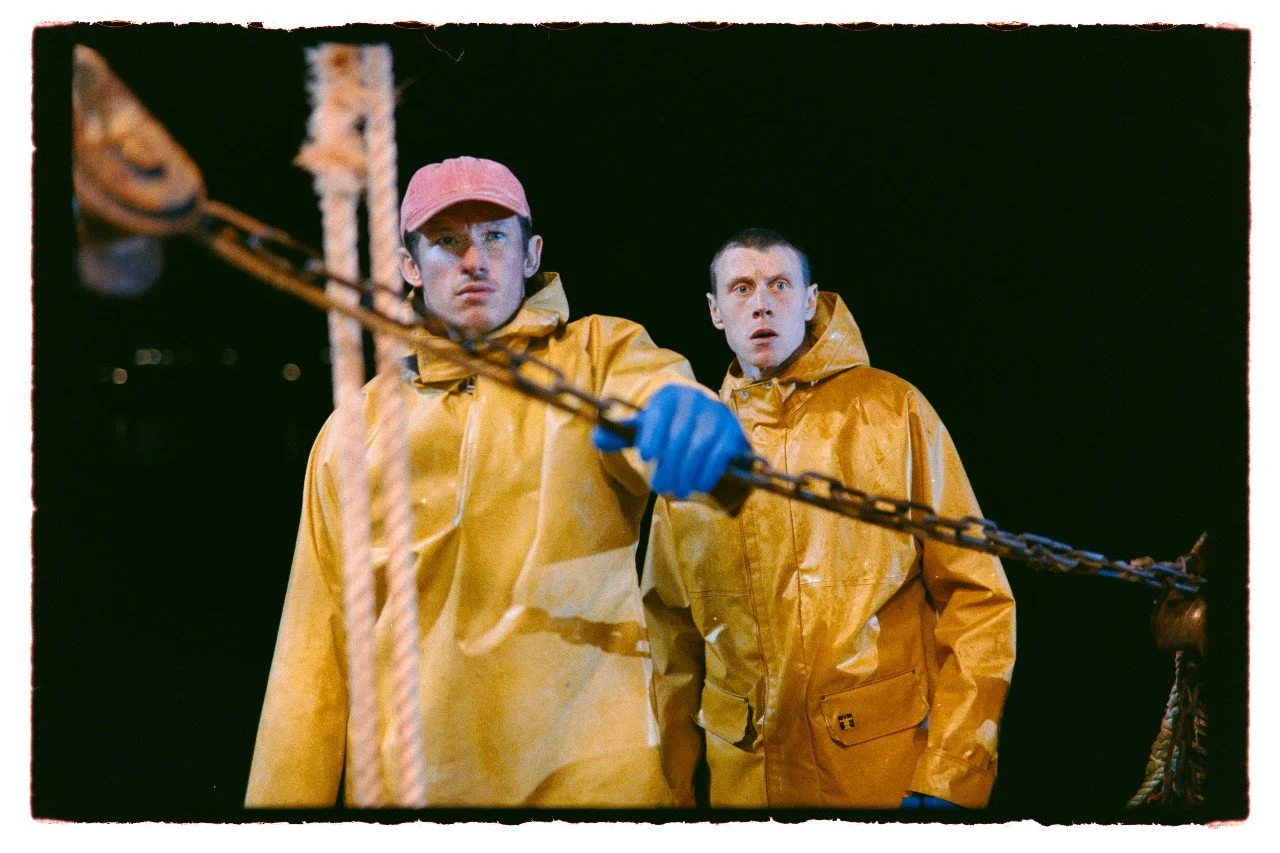
Written and directed by Mark Jenkin (Enys Men), it tells the story of a Cornish village that is dowdy and down on its luck, with inhabitants to match. Nick (George MacKay) is struggling to provide for his wife and daughter, and their flat has a hole in the roof that he can’t fix. Liam (Callum Turner) has it even worse, flirting with a woman at the pub in the hope of scoring a drink.
Their fortunes seem to change when the titular boat appears in the harbour one day. The oddity is that it went missing 30 years ago, with all hands lost. Refusing to look this gift horse in the mouth, its owner hires Nick and Liam, and the mysterious captain Murgey (Francis Magee), to immediately set to sea in search of fish.
They are very successful; the little boat’s hold is soon full. But when they return to port, they find that 30 years have rolled away like an ebb tide. It’s 1993. Nick was born in 1996.

Even more strange, Nick and Liam are no longer themselves. They still feel like themselves (and are played by the same actors), but Nick is now seen as Luke, the son of his neighbours, who was not on the Rose of Nevada that fateful day and later killed himself out of grief and guilt. And Liam is now Alan, who has a wife and a child and did get lost at sea.
Blockbuster time travel tales don’t spend a lot of time on the existential angst of the journey — think Bill and Ted, The Terminator or Back to the Future, where Marty’s meditation never got much deeper than “This is heavy, Doc!” But there are plenty of counterexamples, such as Looper, Twelve Monkeys (based on La Jetée) or the 2007 masterpiece TimeCrimes.
Rose of Nevada definitely falls into the “thoughtful” camp. For one thing, its protagonists experience such different outcomes from the event. Liam, formerly rootless, now has a wife and a daughter that adore him, and is making a decent wage.
Nick conversely has lost his family, and the flat where he used to (or I guess will one day) live is now empty. All he has is a scrap of paper that says, “We love you!” reminiscent of the flower in the pocket of the traveller in the H.G. Wells novel.
In one achingly sad sequence he mails his pay and that note to his future wife at their future address, only to have it delivered there in a present he can’t escape. They go to sea again, but it’s still John Major at 10 Downing Street when they get back.
Jenkin fills his film with portents of dread that flirt with the horror genre, like a warning scratched in the bunk on the Rose of Nevada, or the disturbing dreams suffered by Nick, and apparently only Nick.
Sudden scene changes intensify the sense of dislocation, and there are motifs (boots hitting the ground, the drumbeat of a ship’s engine) that rattle away like a ticking clock. I also spotted at least one moment where time itself seemed to run backward, an eerie and suggestive shot.
As with many an art house project, the final scene of Rose of Nevada is left open to a certain amount of interpretation. I was disappointed — I wanted answers! — but I place the blame here on the critic, not the movie.
Besides, the lack of a tidy conclusion will just make the story sit with me that much longer and more deeply. It would have been a much more troubling ending if the fishermen had declared: “Roe? Where we’re going we don’t need… roe.”
CLICK HERE to see Bonnie Laufer’s interview with Rose of Nevada director Mark Jenkin.
Rose of Nevada. Directed by Mark Jenkin. Starring George MacKay, and Callum Turner. In theatres July 10.